



Solar Battery Charger
Date : October 20203-4 Min
Posted on : 16 May 2022
Tag(s) : Solar Project, Batteries
The sun is by far the most important object in our sky because it drives and is responsible for almost all activities here on earth. From providing energy to plants through photosynthesis to warming up our planet and keeping it at temperatures that allow life to exist. So why the quest for energy sources when the biggest and most ample one is right above our heads sending us packets of energy (photons) everyday? Solar panels are quite fascinating and in my opinion the right step towards a green and sustainable world. This post is a short review of a battery charging circuit i was using based on a 12V solar panel.
The solar panels i was using were very basic. The first one was rated 12V, 2W, and with a short current supply of 200mA, while another one was 5.5V 500mW 90mA. They are not very powerful but they are a good starting point to learn more about solar panels and to become more fascinated with their splendor. They were being used to charge nickel metal hydride batteries (NIMH) with norminal voltages of 3.6V and 8.4V, aswell as current capacities of 360mAH and 200mAH respectively. Later on i used them to charge a 6V 1.4Ah lead-acid battery. The 12V solar panel was providing 30mA of current on average so it took about 14 hours to charge the 3.6V NIMH battery and 4 days to charge the larger lead-acid battery. So charge times were slow but also susceptible to weather conditions.
The picture below shows the solar panels being used to charge the 8.4V NIMH battery and the 3.6V cells. The batteries are being charged by different solar panels and are connected to different points on the circuit because each battery has a different voltage rating.

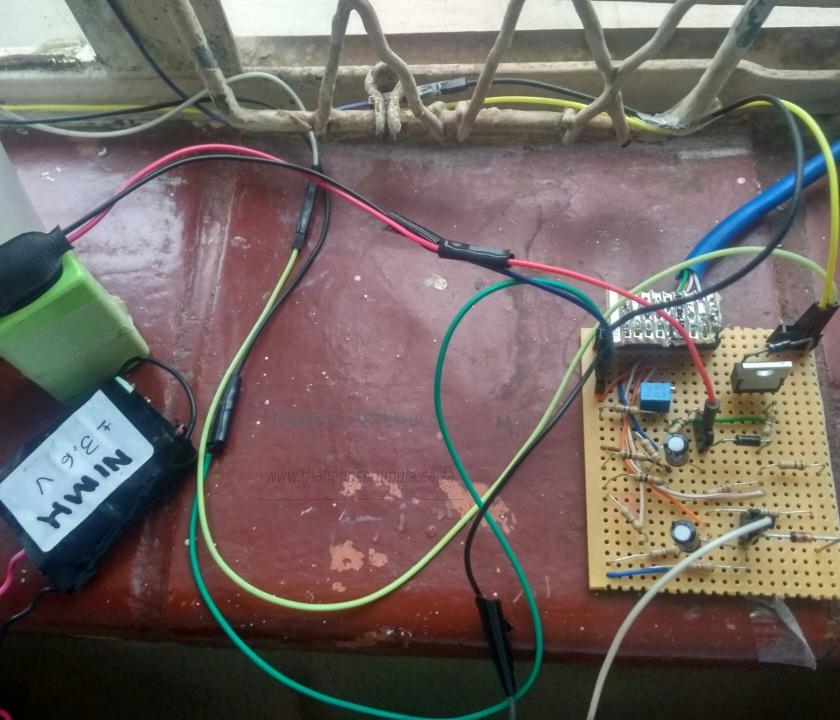
The battery charger is connected to a microcontroller that monitors the battery voltages and sends the analog-to-digital (ADC) data samples to a PC. I wrote a separate article about the data sampler. The picture below shows a plot of the data samples from the battery charging circuit over a 24 hour period.
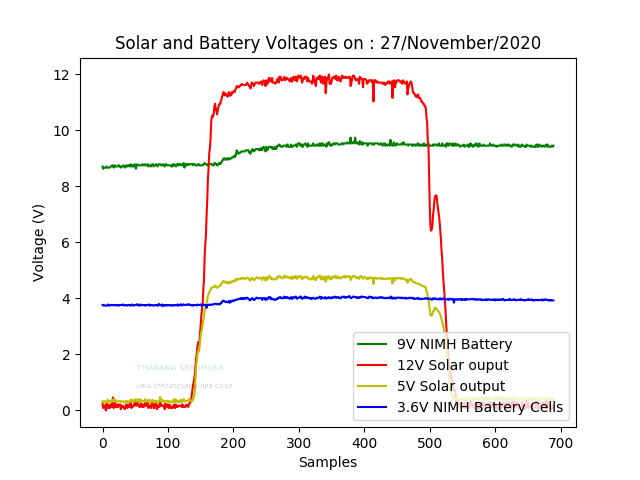
Overall this is a very exciting project. It would be nice if the charging times can be reduced by using even more capable solar panels but the problem is that increasing the power of solar panels usually requires increasing the surface area of the panels aswell. Large solar panels are undesirable for just charging such small batteries. The industry requires more breakthroughs in solar technology to help make solar panels more efficient and usable in everyday electronics.