


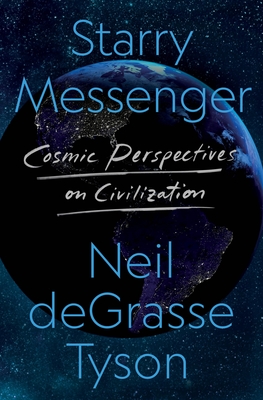
Starry Messenger: Cosmic Perspectives on Civilization
My Thoughts :
This is a great book overall. The author provides readers with an enlightening and thought-provoking perspective on different aspects of our lives, the world we live in, and the universe at large.
From the eyes of an astrophysicist, or rather, from the perspective of extraterrestrial species looking down on Earth—a starry messenger—the book offers a dire warning to our civilization and shows just how backward we may actually be.
The author discusses various topics that generally have some impact on our lives, such as politics, global conflicts, the society we live in, the food we eat, and justice under the court of law. But most importantly, how Science may be the best tool we have to dismantle stereotypes, racism, sexism, and many conflicts taking place in the world. More than just a tool, the scientific way of thinking can also be an enlightening experience, an artistic experience, a spiritual experience. It enables us to see and embrace the beauty of the cosmos for what it truly is rather than what we wish it to be. It gives us the cosmic perspective.
The last chapter of the book is simply brilliant and stands out from the rest of the book in many ways. It is one of the most beautiful things Neil deGrasse Tyson has ever written and definitely something that will be part of his legacy and for which he will be remembered.
Details :
- Author : Neil deGrasse Tyson
- Release Date : 2022
- Publisher : Harper Collins
- ISBN : 978-0-00-854321-1
Read : 10 Mar 2024 - 16 Mar 2024
Favourite Quotes :
After thinking deeply about how a scientist views the world, about what Earth looks like from space, and about the magnitude of cosmic age and of infinite space, all terrestrial thoughts change. Your brain recalibrates life’s priorities and reassesses the actions one might take in response. No outlook on culture, society, or civilization remains untouched. In that state of mind, the world looks different. You are transported. You experience life through the lens of a cosmic perspective. [6] It’s no secret that people will give their lives, or take the lives of others, in support of what they believe. Often the less actual evidence that exists in support of an ideology, the more likely a person is willing to die for the cause. Aryan Germans of the 1930s weren’t born thinking they were the master race to all other people in the world. They had to be indoctrinated. And they were. By an efficient, lubricated political machine. By 1939 and the start of World War II, millions were ready to die for it—and did. [11] Contrary to implicit tenets of the green movement, not all that is natural is beautiful, and not all that is beautiful is natural. [21] I’m instead plagued by a simpler thought that, as a species, we might not possess the maturity or wisdom the future requires to assure the survival of civilization. [46] Now combine an inexplicably darkened sky with a deeply religious, Bible-fluent Christian, and you are pleading for God’s mercy. Without the clouds, the solar eclipse becomes an educational spectacle for the whole family. [59] Knowledge of the universe—cosmic perspectives in particular—simultaneously disconnects our ego from all that happens in the sky yet fosters accountability for all we do, preventing us from either crediting or blaming the sky for our earthly affairs. [60] Part the curtains of all-out conflict and find the puppeteers of politics and religion. Two topics that, we are warned, should never be discussed in polite company. Two topics with a lot in common for how deeply personal they can be. Two topics that, when disagreements are severe, can lead to bloodshed and full-blown war. [62] All this leaves me wondering what it means to be aligned with a political party at all. Do they do your thinking for you? Do they define your attitudes toward issues that confront the country? If so, then you are a pawn of those in power. [78] "One of the greatest pains to human nature is the pain of a new idea." - Walter Bagehot.[100] The urge to categorize and create an “other” is strong, perhaps because it’s more difficult to think about whether a continuum connects you to that person, or to any other person you deem different from yourself. Biology itself won’t bail you out of this one. The presumed binary of sex in nature is overrated and rife with exceptions, not only in ourselves but also in the rest of the animal kingdom. [132] That’s when I reckoned the massive investments we all make in gender expression. Want to look more like a man? Maybe grow a mustache or beard. But certainly visit the gym and build some muscles. Buy clothes only in the men’s section of department stores. Fashion designers have already thought about this for you. Choose clothes that reveal your new physique. Want to look more like a woman? Remove hair from above your lip, between your eyebrows, up and down your legs, and other places you might designate. Because everyone knows that men are hairy and women are not. Breasts not large enough? Those are important because men don’t have breasts and women do. So why not boost those. Wear bras that accentuate what you have, or surgically increase their size, as more than 200,000 women do annually in the US.8 Buy clothes only from the women’s section of the department store. They definitely know what you’re supposed to look like. [132] --our brains don’t do well on a continuum, preferring instead to manufacture categories that nature itself does not provide. [135] One day, we may discover or otherwise affirm no discrete categories at all, as the multidimensional gender universe unfolds along a continuum, like the colors contained in sunlight. This will significantly dilute the power of homophobic and transphobic bigots to declare that they are somehow separate and distinct from other members of their own species. [136] My urge is to gesture a forgiving nod to the past while I display a furrowed brow to the future, wondering how today’s most progressive creations may appear to our ever-more-enlightened descendants a hundred years from now. [149] Why would anyone want to feel superior to others? Surely the only occasion to justify looking down on someone is while you are helping them up. Not being a psychologist, I claim no special insight other than to share the observation itself. What’s clear is that some people feel better when they believe other people are less than they are, in any way they value, which could include wealth, intelligence, talent, beauty, or education. Add strength, speed, grace, agility, and endurance and you’ve compiled most of the ways people persistently compare themselves to others, either informally or in organized settings. [149] Look how easy it is to be racist. [156] Imagine you’re offered the opportunity to enter a time machine and go back to any previous moment in human history. Where and when would you choose? The White, cisgender, heterosexual male has his pick of the timeline—this traveler to the past will be welcomed everywhere and everywhen. If that’s not you, then you’d better think hard about the time and place you’d like to arrive. Are you female, a person of color, disabled, queer, or any combination of these? When was it better for you? A thousand years ago? Five hundred? A hundred? Fifty years ago? Ten? Five? For me, I’m good with the present. [165] The clarion call to fund practical research over fundamental research, and the persistent plea to not spend money in space when we could spend it on Earth, represent noble but underinformed desires. Want to advance civilization? Fund it all. You never know beforehand which discoveries will transform your field, birthed in professions not your own. [192] Legal systems at their best are prerequisites for anything we call civilization, as they protect us from the destabilizing basal urges of our own primal instincts. Ask yourself, how would people behave if no threat of legal action existed in this world? Look at how many people transgress established laws even with a legal system in place. Without it, there’s not much hope for civilization. [169] Crowd justice is the precise recipe for lynchings. Today, crowds cancel people on the internet; welcome to the court of public opinion and not the court of law. A tally of up and down votes, where people get to weigh in on what they want to be true, or what ought to be true, and not on what is actually true. To find out what is actually true requires careful and thorough investigations and not the simple act of reading media accounts and forming your opinion based on them. [172] In fact, we breed future lawyers to wield such powers of persuasion. Fertile feeders to the legal profession include debating clubs in high schools and colleges across the country. Was never much interested, myself, even though my high school fielded a particularly competitive and successful debate team. Their hallway cabinets were chock-full of trophies. Not so much for our sports teams. Regardless, I was a full-on adult before I learned what actually happens at these tournaments. The debaters are given the topics that will be covered, except they don’t know what side of the debate they will be assigned to argue until the day of the contest. The winner is the person or the team that makes their case most convincingly to the judges. The goal is not to find out what is objectively true about anything. Instead, the entire system trains you to argue—either side of any subject. The rules also presuppose that all topics of debate have only two sides to them. Not three. Not five. Not a continuum. Learning of this, as a budding scientist, I could think of nothing more disruptive to the search for truth than this breeding ground of arguers. [174] Also, consider that morals evolve across time and culture, typically by rational analysis of the effects and consequences of previously held morals, in the light of emergent knowledge, wisdom, and insight. The Bible, for example, often held up as a source of morality, is not a fertile place to find antislavery commentary, nor discussions of gender equality. [183] --just do what you love, regardless of others’ efforts to dissuade you. You may just succeed famously in the face of naysayers who seek to standardize who should or shouldn’t succeed at all. [199] Those who were seen dancing were thought to be insane by those who could not hear the music. [199] Maybe everybody is disabled in some way. If so, that means nobody is disabled. [199] Since we can’t meaningfully communicate with any other species of life on Earth—not even those genetically closest to us—how audacious of us to think we can converse at all with intelligent alien life upon first meeting them. Cosmic perspectives wield the power to humble our human hubris, with full justification for doing so. But the question remains, do we have a seat at the table among the intelligent life-forms of the universe? Do we possess sufficient smarts to answer the cosmic questions we’ve posed? Do we possess sufficient intelligence to even know what questions to ask? [203] Suppose we could live forever. It’s better to be alive than dead. Though more often than not, we take being alive for granted. The question remains, if you could live forever, would you? To live forever is to have all the time in the world to do anything you ever wanted. You can even mutiny a generation starship and return home to Earth if you wanted to. Seems like an attractive idea, but maybe the knowledge of death creates the focus that we bring to being alive. If you live forever, then what’s the hurry? Why do today what you can put off until tomorrow. There is perhaps no greater de-motivating force than the knowledge you will live forever. If true, then knowledge of your mortality may also be a force unto itself—the urge to achieve, and the need to express love and affection now, not later. [207] Mathematically, if death gives meaning to life, then to live forever is to live a life with no meaning at all. [207] Not everything dies for having grown old. Contrary to the collective delusion that Mother Nature is a nurturing, caring entity that cradles and protects all its forms of life, Earth is instead a giant killing machine. Holding aside all the climatic and geologic forces that would just as soon have you dead, such as droughts, floods, hurricanes, tornadoes, earthquakes, tsunamis, and volcanoes, there’s no end of creatures that want to suck your blood, inject you with venom, infect your physiology, or simply eat you. The universe wants to kill you too. [209] --but when I die, I’d rather be buried. My infrared energy crossing the vacuum of space is of no use to anybody or anything at any time. Put me in the ground, six feet under, and let the worms and microbes crawl in and out of my carcass as they dine upon my flesh. Let the root systems of the plant and fungal kingdoms of life extract nutrients from my body. The energy content of my molecules, which I had assembled throughout my lifetime by consuming the flora and fauna of this Earth, will return to them, continuing the biosphere’s cycle of life. [211] On the whole, I don’t fear death. Instead, I fear a life where I could have accomplished more. [215] Our primal urge to keep looking up is surely greater than our primal urge to keep killing one another. If so, then human curiosity and wonder, the twin chariots of cosmic discovery, will ensure that starry messages continue to arrive. These insights compel us, for our short time on Earth, to become better shepherds of our own civilization. Yes, life is better than death. Life is also better than having never been born. But each of us is alive against stupendous odds. We won the lottery—only once. We get to invoke our faculties of reason to figure out how the world works. But we also get to smell the flowers. We get to bask in divine sunsets and sunrises, and gaze deeply into the night skies they cradle. We get to live, and ultimately die, in this glorious universe. [216]