

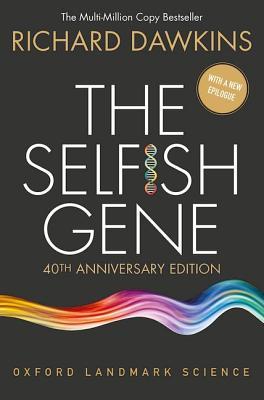
The Selfish Gene
My Thoughts :
Details :
- Author : Richard Dawkins
- Release Date : 2016 (First published 1976)
- Publisher : Oxford University Press
- ISBN : 978-0-1987-8860-7
- Read : 21 April 2023 - 16 May 2023
Favourite Quotes :
Natural selection therefore sees to it that gangs of mutually compatible—which is almost to say cooperating—genes are favoured in the presence of each other. [XI] The chimpanzee and the human share about 99.5 per cent of their evolutionary history, yet most human thinkers regard the chimp as a malformed, irrelevant oddity while seeing themselves as stepping-stones to the Almighty. [XXV] Anyone can popularize science if he oversimplifies [XXIV] Often altruism within a group goes with selfishness between groups. This is a basis of trade unionism. At another level the nation is a major beneficiary of our altruistic self-sacrifice, and young men are expected to die as individuals for the greater glory of their country as a whole. Moreover, they are encouraged to kill other individuals about whom nothing is known except that they belong to a different nation. (Curiously, peace-time appeals for individuals to make some small sacrifice in the rate at which they increase their standard of living seem to be less effective than war-time appeals for individuals to lay down their lives.) [12] the fundamental unit of selection, and therefore of self-interest, is not the species, nor the group, nor even, strictly, the individual. It is the gene, the unit of heredity. [14] but a man consists of over a thousand million million million million atoms. [17] At some point a particularly remarkable molecule was formed by accident. We will call it the replicator. It may not necessarily have been the biggest or the most complex molecule around, but it had the extraordinary property of being able to create copies of itself. This may seem a very unlikely sort of accident to happen. So it was. It was exceedingly improbable. In the lifetime of a man, things that are that improbable can be treated for practical purposes as impossible. [19] The answer is that although evolution may seem, in some vague sense, a ‘good thing’, especially since we are the product of it, nothing actually ‘wants’ to evolve. Evolution is something that happens, willy-nilly, in spite of all the efforts of the replicators (and nowadays of the genes) to prevent it happening. [22] They have come a long way, those replicators. Now they go by the name of genes, and we are their survival machines. [25] Another aspect of the particulateness of the gene is that it does not grow senile; it is no more likely to die when it is a million years old than when it is only a hundred. It leaps from body to body down the generations, manipulating body after body in its own way and for its own ends, abandoning a succession of mortal bodies before they sink in senility and death. [43] The genes are the immortals, or rather, they are defined as genetic entities that come close to deserving the title. We, the individual survival machines in the world, can expect to live a few more decades. But the genes in the world have an expectation of life that must be measured not in decades but in thousands and millions of years.[ 43] A population is not a discrete enough entity to be a unit of natural selection, not stable and unitary enough to be ‘selected’ in preference to another population. [43] Individuals are not stable things, they are fleeting. Chromosomes too are shuffled into oblivion, like hands of cards soon after they are dealt. But the cards themselves survive the shuffling. The cards are the genes. The genes are not destroyed by crossing-over, they merely change partners and march on. Of course they march on. That is their business. They are the replicators and we are their survival machines. When we have served our purpose we are cast aside. But genes are denizens of geological time: genes are forever. [44] The gene is the basic unit of selfishness. [46] I am frankly going to evade it except to say one thing. This is that at least some of the difficulty that theorists have with explaining the evolution of sex results from the fact that they habitually think of the individual as trying to maximize the number of his genes that survive. The genes too control the behaviour of their survival machines, not directly with their fingers on puppet strings, but indirectly like the computer programmer. [68] Genes don’t have reaction-times like that. Like the Andromedans, the genes can only do their best in advance by building a fast executive computer for themselves, and programming it in advance with rules and ‘advice’ to cope with as many eventualities as they can ‘anticipate’. But life, like the game of chess, offers too many different possible eventualities for all of them to be anticipated. Like the chess programmer, the genes have to ‘instruct’ their survival machines not in specifics, but in the general strategies and tricks of the living trade. [71] Prediction in a complex world is a chancy business. Every decision that a survival machine takes is a gamble, and it is the business of genes to program brains in advance so that on average they take decisions that pay off. [72] In some ways the stock market is a better analogy than a casino, because casinos are deliberately rigged in the bank’s favour (which means, strictly, that high-stake players will on average end up poorer than low-stake players; and low-stake players poorer than those who do not gamble at all. [73] In Chapter 9 we shall see that it is often possible to picture males as high-stake, high-risk gamblers, and females as safe investors, especially in polygamous species in which males compete for females. [73] Survival machines that can simulate the future are one jump ahead of survival machines who can only learn on the basis of overt trial and error. The trouble with overt trial is that it takes time and energy. The trouble with overt error is that it is often fatal. Simulation is both safer and faster. [76] Genes are the primary policy-makers; brains are the executives. [77] Biologists often speak of the biological advantage or ‘function’ of dominance hierarchies as being to reduce overt aggression in the group. However, this is the wrong way to put it. A dominance hierarchy per se cannot be said to have a ‘function’ in the evolutionary sense, since it is a property of a group, not of an individual. The individual behaviour patterns that manifest themselves in the form of dominance hierarchies when viewed at the group level may be said to have functions. [108] But there are other ways in which the interests of individuals from different species conflict very sharply. For instance a lion wants to eat an antelope’s body, but the antelope has very different plans for its body. This is not normally regarded as competition for a resource, but logically it is hard to see why not. [108] I have a hunch that we may come to look back on the invention of the ESS concept as one of the most important advances in evolutionary theory since Darwin. - In the long term, I expect the ESS concept to revolutionize the science of ecology. [109] It may look as though the population as a whole is behaving like a single self-regulating unit. But this illusion is produced by selection going on at the level of the single gene. Genes are selected on ‘merit’. But merit is judged on the basis of performance against the background of the evolutionarily stable set which is the current gene pool. [113] So we conclude that the ‘true’ relatedness may be less important in the evolution of altruism than the best estimate of relatedness that animals can get. This fact is probably a key to understanding why parental care is so much more common and more devoted than brother/sister altruism in nature, and also why animals may value themselves more highly even than several brothers. [136] In a world where other individuals are constantly on the alert for opportunities to exploit kin-selected altruism, and use it for their own ends, a survival machine has to consider who it can trust, who it can be really sure of. [137] In many species a mother can be more sure of her young than a father can. The mother lays the visible, tangible egg, or bears the child. She has a good chance of knowing for certain the bearers of her own genes. The poor father is much more vulnerable to deception. It is therefore to be expected that fathers will put less effort than mothers into caring for young. [138] Individuals who have too many children are penalized, not because the whole population goes extinct, but simply because fewer of their children survive. Genes for having too many children are just not passed on to the next generation in large numbers, because few of the children bearing these genes reach adulthood. [152] Similarly, the many other examples where animals appear to ‘accept’ non-reproductive status passively can be explained quite easily by the selfish gene theory. [154] individual parents practise family planning, but in the sense that they optimize their birth rates rather than restrict them for public good. They try to maximize the number of surviving children that they have, and this means having neither too many babies nor too few. Genes that make an individual have too many babies tend not to persist in the gene pool, because children containing such genes tend not to survive to adulthood. [158] In practice, however, it is unlikely that females would impose such arbitrary tasks as dragon-killing, or Holy-Grail-seeking on their suitors. The reason is that a rival female who imposed a task no less arduous, but more useful to her and her children, would have an advantage over more romantically minded females who demanded a pointless labour of love. Building a nest may be less romantic than slaying a dragon or swimming the Hellespont, but it is much more useful. [200] Faced with these facts, a biologist would be forced to suspect that he was looking at a society in which females compete for males, rather than vice versa. In the case of birds of paradise, we decided that females are drab because they do not need to compete for males. Males are bright and ostentatious because females are in demand and can afford to be choosy. The reason female birds of paradise are in demand is that eggs are a more scarce resource than sperms. What has happened in modern western man? Has the male really become the sought-after sex, the one that is in demand, the sex that can afford to be choosy? If so, why? [215] The majority of individuals in a social insect colony are sterile workers. The ‘germ line’—the line of immortal gene continuity—flows through the bodies of a minority of individuals, the reproductives. These are the analogues of our own reproductive cells in our testes and ovaries. The sterile workers are the analogy of our liver, muscle, and nerve cells. Kamikaze behaviour and other forms of altruism and cooperation by workers are not astonishing once we accept the fact that they are sterile. The body of a normal animal is manipulated to ensure the survival of its genes both through bearing offspring and through caring for other individuals containing the same genes.[224] The point I am making now is that, even if we look on the dark side and assume that individual man is fundamentally selfish, our conscious foresight—our capacity to simulate the future in imagination—could save us from the worst selfish excesses of the blind replicators. We have at least the mental equipment to foster our long-term selfish interests rather than merely our short-term selfish interests. [260] We have the power to defy the selfish genes of our birth and, if necessary, the selfish memes of our indoctrination. We can even discuss ways of deliberately cultivating and nurturing pure, disinterested altruism—something that has no place in nature, something that has never existed before in the whole history of the world. We are built as gene machines and cultured as meme machines, but we have the power to turn against our creators. We, alone on earth, can rebel against the tyranny of the selfish replicators. [260] we have identified two characteristics of winning strategies: niceness and forgivingness. This almost utopian-sounding conclusion—that niceness and forgivingness pay—came as a surprise to many of the experts, who had tried to be too cunning by submitting subtly nasty strategies; while even those who had submitted nice strategies had not dared anything so forgiving as Tit for Two Tats. [275] But once again nastiness didn't pay [275] Tit for Tat itself, indeed, came out top in five out of six runs of Round 3, just as it had in Rounds 1 and 2. Five other nice but provocable strategies ended up nearly as successful (frequent in the population) as Tit for Tat; indeed, one of them won the sixth run. When all the nasties had been driven extinct, there was no way in which any of the nice strategies could be distinguished from Tit for Tat or from each other, because they all, being nice, simply played cooperate against each other. [279] Tit for Tat is also ‘not envious’. To be envious, in Axelrod’s terminology, means to strive for more money than the other player, rather than for an absolutely large quantity of the banker’s money. To be non-envious means to be quite happy if the other player wins just as much money as you do, so long as you both thereby win more from the banker. Tit for Tat never actually ‘wins’ a game. Think about it and you’ll see that it cannot score more than its ‘opponent’ in any particular game because it never defects except in retaliation. The most it can do is draw with its opponent. But it tends to achieve each draw with a high, shared score. Where Tit for Tat and other nice strategies are concerned, the very word ‘opponent’ is inappropriate. [284] Sadly, however, when psychologists set up games of Iterated Prisoner’s Dilemma between real humans, nearly all players succumb to envy and therefore do relatively poorly in terms of money. It seems that many people, perhaps without even thinking about it, would rather do down the other player than cooperate with the other player to do down the banker. Axelrod’s work has shown what a mistake this is. [285] Prisoner’s Dilemma, however, is a nonzero sum game. There is a banker paying out money, and it is possible for the two players to link arms and laugh all the way to the bank. This talk of laughing all the way to the bank reminds me of a delightful line from Shakespeare: The first thing we do, let’s kill all the lawyers. 2 Henry VI [285] In what are called civil ‘disputes’ there is often in fact great scope for cooperation. What looks like a zero sum confrontation can, with a little goodwill, be transformed into a mutually beneficial nonzero sum game. [285] The hapless couple have been dragged into a zero sum game. For the lawyers, however, the case of Smith v. Smith is a nice fat nonzero sum game, with the Smiths providing the pay-offs and the two professionals milking their clients’ joint account in elaborately coded cooperation. [286] The system works without any conscious overseeing or organizing. It is all geared to forcing us into zero sum games. Zero sum for the clients, but very much nonzero sum for the lawyers. [286] Many situations in real life are, as a matter of fact, equivalent to nonzero sum games. Nature often plays the role of ‘banker’, and individuals can therefore benefit from one another’s success. They do not have to do down rivals in order to benefit themselves. Without departing from the fundamental laws of the selfish gene, we can see how cooperation and mutual assistance can flourish even in a basically selfish world. We can see how, in Axelrod’s meaning of the term, nice guys may finish first. [289] A computer program can behave in a strategic manner, without being aware of its strategy or, indeed, of anything at all. [295] Axelrod’s programs are an exellent model for the way we, throughout the book, have been thinking of animals and plants, and indeed of genes. So it is natural to ask whether his optimistic conclusions—about the success of non-envious, forgiving niceness—also apply in the world of nature. The answer is yes, of course they do. The only conditions are that nature should sometimes set up games of Prisoner’s Dilemma, that the shadow of the future should be long, and that the games should be nonzero sum games. These conditions are certainly met, all round the living kingdoms. [296] replicators that are mutually beneficial will come to predominate in each other’s presence. [343] the replicators come first, in importance as well as in history. [343] But the individual body, so familiar to us on our planet, did not have to exist. The only kind of entity that has to exist in order for life to arise, anywhere in the universe, is the immortal replicator. [344] The Selfish Gene is quite likely a valid account of life on other planets even if the genes on those other planets have no connection with DNA. [349]