


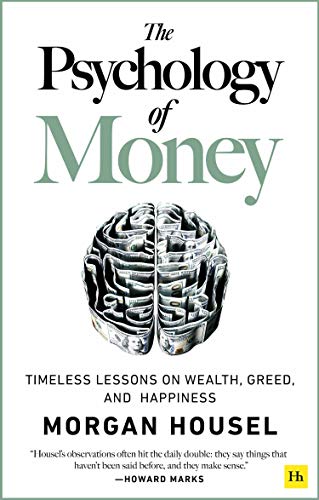
The Psychology of Money : Timeless Lessons on Wealth, Greed, and Happiness
My Thoughts :
Details :
- Author : Morgan Housel
- Release Date : 2020
- Publisher : Harriman House
- ISBN : 978-0-85719-768-9
Read : 04 Nov 2023 - 12 Dec 2023
Favourite Quotes :
For every Bill Gates there is a Kent Evans who was just as skilled and driven but ended up on the other side of life roulette. If you give luck and risk their proper respect, you realize that when judging people’s financial success—both your own and others’—it’s never as good or as bad as it seems. [28] We similarly think Mark Zuckerberg is a genius for turning down Yahoo!’s 2006 $1 billion offer to buy his company. He saw the future and stuck to his guns. But people criticize Yahoo! with as much passion for turning down its own big buyout offer from Microsoft—those fools should have cashed out while they could! What is the lesson for entrepreneurs here? I have no idea, because risk and luck are so hard to pin down. [32] “The customer is always right” and “customers don’t know what they want” are both accepted business wisdom. The line between “inspiringly bold” and “foolishly reckless” can be a millimeter thick and only visible with hindsight. [32] Studying a specific person can be dangerous because we tend to study extreme examples—the billionaires, the CEOs, or the massive failures that dominate the news—and extreme examples are often the least applicable to other situations, given their complexity. The more extreme the outcome, the less likely you can apply its lessons to your own life, because the more likely the outcome was influenced by extreme ends of luck or risk. [33] If expectations rise with results there is no logic in striving for more because you’ll feel the same after putting in extra effort. [41] “The only way to win in a Las Vegas casino is to exit as soon as you enter.” [42] --the inability to deny a potential dollar will eventually catch up to you. [43] The big takeaway from ice ages is that you don’t need tremendous force to create tremendous results. If something compounds—if a little growth serves as the fuel for future growth—a small starting base can lead to results so extraordinary they seem to defy logic. It can be so logic-defying that you underestimate what’s possible, where growth comes from, and what it can lead to. And so it is with money. [49] Getting money is one thing. Keeping it is another. [59] Not “growth” or “brains” or “insight.” The ability to stick around for a long time, without wiping out or being forced to give up, is what makes the biggest difference. [60] Planning is important, but the most important part of every plan is to plan on the plan not going according to plan. [63] you need short-term paranoia to keep you alive long enough to exploit long-term optimism. [66] The ability to do what you want, when you want, with who you want, for as long as you want, is priceless. It is the highest dividend money pays. [83] Part of what’s happened here is that we’ve used our greater wealth to buy bigger and better stuff. But we’ve simultaneously given up more control over our time. At best, those things cancel each other out. [86] Rockefeller was a strange guy. But he figured out something that now applies to tens of millions of workers. Rockefeller’s job wasn’t to drill wells, load trains, or move barrels. It was to think and make good decisions. Rockefeller’s product—his deliverable—wasn’t what he did with his hands, or even his words. It was what he figured out inside his head. So that’s where he spent most of his time and energy. Despite sitting quietly most of the day in what might have looked like free time or leisure hours to most people, he was constantly working in his mind, thinking problems through. [87] More of us have jobs that look closer to Rockefeller than a typical 1950s manufacturing worker, which means our days don’t end when we clock out and leave the factory. We’re constantly working in our heads, which means it feels like work never ends. [88] Compared to generations prior, control over your time has diminished. And since controlling your time is such a key happiness influencer, we shouldn’t be surprised that people don’t feel much happier even though we are, on average, richer than ever. [89] There is a paradox here: people tend to want wealth to signal to others that they should be liked and admired. But in reality those other people often bypass admiring you, not because they don’t think wealth is admirable, but because they use your wealth as a benchmark for their own desire to be liked and admired. [93] Wealth is what you don't see [95] Wealth is financial assets that haven’t yet been converted into the stuff you see. [98] When most people say they want to be a millionaire, what they might actually mean is “I’d like to spend a million dollars.” And that is literally the opposite of being a millionaire. [98] But wealth is hidden. It’s income not spent. Wealth is an option not yet taken to buy something later. Its value lies in offering you options, flexibility, and growth to one day purchase more stuff than you could right now. [99] When you define savings as the gap between your ego and your income you realize why many people with decent incomes save so little. It’s a daily struggle against instincts to extend your peacock feathers to their outermost limits and keep up with others doing the same. [106] Experiencing specific events does not necessarily qualify you to know what will happen next. In fact it rarely does, because experience leads to overconfidence more than forecasting ability. [124] The thing that makes tail events easy to underappreciate is how easy it is to underestimate how things compound. [126] The most important economic events of the future—things that will move the needle the most—are things that history gives us little to no guide about. They will be unprecedented events. Their unprecedented nature means we won’t be prepared for them, which is part of what makes them so impactful. This is true for both scary events like recessions and wars, and great events like innovation. [128] The ability to do what you want, when you want, for as long as you want, has an infinite ROI. [143] The biggest single point of failure with money is a sole reliance on a paycheck to fund short-term spending needs, with no savings to create a gap between what you think your expenses are and what they might be in the future. [145] Everything has a price, and the key to a lot of things with money is just figuring out what that price is and being willing to pay it. The problem is that the price of a lot of things is not obvious until you’ve experienced them firsthand, when the bill is overdue. [157] It’s hard to grasp that other investors have different goals than we do, because an anchor of psychology is not realizing that rational people can see the world through a different lens than your own. Rising prices persuade all investors in ways the best marketers envy. They are a drug that can turn value-conscious investors into dewy-eyed optimists, detached from their own reality by the actions of someone playing a different game than they are. [172] A takeaway here is that few things matter more with money than understanding your own time horizon and not being persuaded by the actions and behaviors of people playing different games than you are. [173] The Seduction of Pessimism -- Optimism sounds like a sales pitch. Pessimism sounds like someone trying to help you. [176] There is an iron law in economics: extremely good and extremely bad circumstances rarely stay that way for long because supply and demand adapt in hard-to-predict ways. [183] Most people, when confronted with something they don’t understand, do not realize they don’t understand it because they’re able to come up with an explanation that makes sense based on their own unique perspective and experiences in the world, however limited those experiences are. We all want the complicated world we live in to make sense. So we tell ourselves stories to fill in the gaps of what are effectively blind spots. [199] Psychologist Philip Tetlock once wrote: “We need to believe we live in a predictable, controllable world, so we turn to authoritative-sounding people who promise to satisfy that need.” [200] Less ego, more wealth. Saving money is the gap between your ego and your income, and wealth is what you don’t see. [207] If you want to do better as an investor, the single most powerful thing you can do is increase your time horizon. Time is the most powerful force in investing. It makes little things grow big and big mistakes fade away. It can’t neutralize luck and risk, but it pushes results closer towards what people deserve. [208] Define the game you’re playing, and make sure your actions are not being influenced by people playing a different game. [209] A culture of equality and togetherness that came out of the 1950s–1970s innocently morphs into a Keeping Up With The Joneses effect. Now you can see the problem. [234] Take that mentality and raise it to the power of Facebook, Instagram, and cable news—where people are more keenly aware of how other people live than ever before. It’s gasoline on a flame. Benedict Evans says, “The more the Internet exposes people to new points of view, the angrier people get that different views exist.” That’s a big shift from the post-war economy where the range of economic opinions were smaller, both because the actual range of outcomes was lower and because it wasn’t as easy to see and learn what other people thought and how they lived. [238] I’m not pessimistic. Economics is the story of cycles. Things come, things go. [238]