


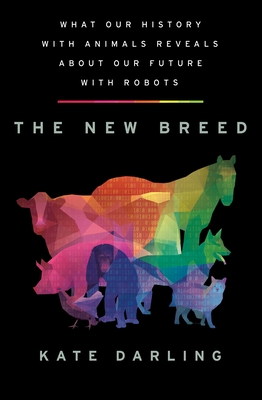
The New Breed: What Our History with Animals Reveals about Our Future with Robots
My Thoughts :
This is very captivating and nicely written. The author gives a fresh perspective on how we should view robots and how they will impact our society by providing a comparison with how we treat animals and how they have helped shape our cities, economy, and the society we live in. The animals are our friends and we have very special relationships with them driven by empathy and our own selfish desires. Something that gives hints on how robots will be integrated in our lives. Overall the book is a very satisfying read and i was sold on the idea from the beginning. Definitely recommend.
Details :
- Author : Kate Darling
- Release Date : 2021
- Publisher : Henry Holt and Co.
Favourite Quotes :
“[M]an had always assumed that he was more intelligent than dolphins because he had achieved so much—the wheel, New York, wars and so on—whilst all the dolphins had ever done was muck about in the water having a good time. But conversely, the dolphins had always believed that they were far more intelligent than man—for precisely the same reasons.” —Douglas Adams, The Hitchhiker’s Guide to the Galaxy We use our own brains as models when thinking about AI in part because historically, the goal of the very first AI developers was exactly that: to re-create human intelligence. And as computer scientist Mark Lee points out: “Despite 60 years of research and theorizing, general purpose AI has not made any progress worth mentioning, and this could even turn out to be an impossible problem.” Computing power doesn’t seem to help with that. We don’t even know how to define human intelligence, let alone structure it in a machine (55) Machines are already much smarter than people in some ways. They have extensive memories, can do huge calculations, and can weld auto parts or perform surgery far more precisely and tirelessly than any human. They can beat human champions at games like chess and Go and Jeopardy! But in many other ways, our abilities outpace those of the machines (56) In 2011, people noticed that when they told Apple’s voice assistant, “Siri, call me an ambulance,” Siri would answer with “OK, from now on I’ll call you ‘an ambulance.’” Bugs like this are eventually corrected, but Siri remains a clumsy conversationalist, at best (56) Today, headlines are filled with new advancements in robotics and artificial intelligence and warnings of a dystopian future where most people’s jobs are replaced by robots. But so far, technology hasn’t driven mass unemployment as many predicted.(58) robots don’t automate jobs; they automate tasks, which means that robots are much more disruptive in sectors where jobs are heavily task oriented(59) The bad news is that there isn’t a lot of incentive to put in that effort when you’re in a capitalist system that’s designed to chase short-term corporate profits rather than long-term investments in humans (68) For some robots, product liability law is an existing piece of the puzzle. Product liability holds anyone who makes products available to the public responsible for injuries that faulty products cause. (99) I worry that by focusing on the robots and their unanticipated behavior, we will start to neglect the accountability of those who create them (100) We’ve long used animals for work and weaponry, but they have also become our friends. And we’re going to start sorting robots into different buckets like tools, products, and companions, just like we’ve done with animals. This is because our relationships with animals are driven by the same impulse that forges human-robot relationships—our tendency to anthropomorphize (128) While the pets no doubt enjoy at least some parts of this lavish treatment, a lot of these services cater to our tendency to project our own desires onto our animals. (136) Studies have shown that people, even though they view dogs as different from children, will falsely attribute similar types of mentalities to both dogs and children (138) Breeding pets for looks can directly follow our anthropomorphic tendencies. In what’s called the “cute response,” we gravitate toward animals that look most like human babies, with big eyes, small noses, and plump, soft bodies. Animals that look like our own young make us want to take care of them, (143) Many of today’s wedding conventions were actually invented by the wedding industry and marketed to people as “traditional,” from the diamond ring to the honeymoon.(180) When we treat some animals as food, products, or tools and other animals as our companions, what determines which animals get which place? (208) The urban middle class viewed the lower classes as unrefined brutes driven by natural urges.. (211) We still favor specific animals in similar laws today. For example, we have special protection for dogs, cats, hamsters, and rabbits in science while at the same time euthanizing millions of the surplus mice we produce for research in the United States each year because they are not needed. (214) It makes sense that animal rights opponents would weaponize animal activists’ selective behavior and accuse them of hypocrisy to discredit them, but anthropomorphism is also controversial within the ranks of the animal rights movement itself. It’s distracting, speciesist, and immoral, some say, to put the most resources toward saving the most humanlike animals. (220) Legally, we treat most animals the same as property and barely any differently than toasters or robots—something that’s undeniably clear when we look at our Kentucky Fried Chicken. (220) the dog’s intrinsic joy is not the only reason we play fetch. It may not even matter very much to us that the dog can feel. Instead, we’re drawn to anthropomorphic social responses, like a wagging tail and “smiling” face. That’s why we keep throwing the ball. (242) This is pretty inconsistent with what a lot of us feel are our values. Surely, we say, we care about other creatures and their experiences and not only about what makes us feel good. But humanity is messy. Our empathy for robots is a revealing part of our psychology. As robots become more widespread in spaces where we can interact with them, this technology will increasingly hold up a mirror that invites us to look at ourselves and be confronted with our human nature. And it is only by acknowledging these uncomfortable truths that we can better understand ourselves. It allows us to both make predictions about our robotic future and also reflect on whether and how we can change (243) We’re human. We’re not going to suddenly act like rational philosophers with consistent moral theories... (244) When it comes to the prediction that artificial intelligence will “outsmart” us within five years, I have two thoughts. First, a simple calculator and an octopus are both vastly smarter than Elon Musk in many ways. Second,....(247) Creating something we already have seems incredibly shortsighted: why would we try to copy-paste human ability into machines if we are capable of so much more than that? .... The true potential of robotics isn’t to re-create what we already have. It’s to build a partner in what we’re trying to achieve (248) My hope is that this book provides a different perspective—one that shows us that we have choices, and also a responsibility, to integrate robots in ways that support human flourishing. Thinking about technology and its challenges in different ways opens a wider solution set and gives us a range of opportunities that we have, and can work toward, to improve our world. After all, it’s not up to the robots to shape the future—it’s up to us. (251)