


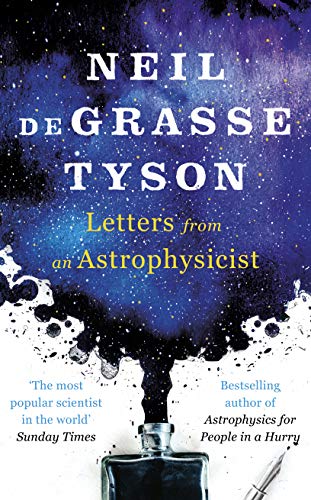
Letters from an Astrophysicist
My Thoughts :
Lovely book. I've always been keen to know more about the public's perception of Science and what questions they have about the natural world. This book does a lovely job at conveying such information through a collection of letters addressed to Dr. Neil Tyson. He offers his writings in response to the letters from his fans and critics, (Neil Tyson style), ranging from Science topics to Philosophy, Politics, Religion and questions about Life itself.
I also like how he ended the book with his own letter addressed to his dad. Truly beautiful and heart-warming to read.
Details :
- Author : Neil deGrasse Tyson
- Release Date : 2019
- Publisher : WH Allen
- ISBN : 978-0-7535-5379-4
Favourite Quotes :
Now that people communicate with one another primarily by social media, letter-writing has become a lost art. The greatest casualty may be our growing inability to find words that precisely communicate our feelings and emotions. Why else the need for that burgeoning catalog of emoticons to supplement our written correspondence? A smiley face. A snarky face. A heart. A thumbs-up. But when the world stimulates your curiosity; when your state of not knowing leaves you restless; when your existential angst overflows; sometimes you just have to write a full-up letter to somebody. [XIII] Hope - It’s all you have when you realize you are not entirely in control of outcomes. But without it, how else do we cope with the challenges of life? (9) Dear Lisa, The people who fail in life are those whose ambitions were insufficient to overcome all the forces that work against them. And yes, failure is common to us all. But ambitious people use their failures as lessons to heed, as they push forward toward their goals. (11) Note further that claims of a “cover-up” or “conspiracy” is the battle cry of people who want to believe, in the face of insufficient data to fully support their claims. (25) Once you confess to not knowing what you are looking at, no logical line of reasoning allows you to then declare that you know what you are looking at. And that includes assertions that the flying shapes “must be” intelligent, technologically advanced aliens from distant planets secretly observing the behavior of Earthlings. You simply bear insufficient evidence to make that jump, however tempting it may be. (25) Over the years, the methods and tools of science have shown us that, despite what some philosophers have claimed, a reality exists independent of our perception of it. We know this because, for example, the laws of gravity are there and work every time, no matter who is doing the experiment, no matter what apparatus you use to measure it, and they work whether or not you choose to believe in them. (37) So you can be awed by the complexities manifest the world, or you can instead be astonished at how simple it all is. [52] For me, however, I have an unorthodox philosophy regarding root-finding. I just don’t care. And that’s not a passive absence of caring it’s an active absence of caring. Since any two people in the world have a common ancestor—depending on how far back you look, the line we draw to establish family lineage is entirely arbitrary. When I wonder what I am capable of as a human being, I don’t look to “relatives,” I look to all human beings. That is the genetic relationship that matters to me. The genius of Isaac Newton, the courage of Joan of Arc and Gandhi, the athletic feats of Michael Jordan, the oratorical skills of Sir Winston Churchill, the compassion of Mother Teresa. I look to the entire human race for inspiration for what I can be—because I am human. I don’t care if I am a descendent of kings or paupers, saints or sinners, the brave or cowardly. My life is what I make of it. [55] How much is the universe worth to you? [87] So your assertion is false and shows a lack of education about the process of science and the nature of discovery. When this happens, it’s usually not the person’s fault, and is traceable to educators in your life who did not spend enough time training you how to think, as distinct from what to think. As for education, I think there ought to be a class in public schools on religion. It occupies an undeniably significant role in civilization. Commensurate with my earlier interest in diversity, the religion class should cover all the world’s faith-based philosophies and belief systems. I think, historically, such a class was omitted because religions themselves are not fans of tolerating other religions. [91] The theory of evolution is not something to “believe in.” Science follows evidence. And when strong evidence supports an idea, the concept of belief, when invoked the way religious people use the word, is unnecessary. In other words, established science is not an ensemble of beliefs, it’s a system of ideas supported by verifiable evidence. You did not ask if I believe in the sunrise. Or if I believe the sky is blue. Or if I believe Earth has a Moon. These are non-controversial truths about the physical world for which the word “believe” has no place. Evolution by natural selection is a non-controversial tenet of modern biology.[99] If faith is a personal construct, then there can be no agreed-upon book of answers. [111] Is there a book of questions with answers provided by spiritual inquiry? (Of course, religion has been at it for many thousands of years.) If such a book exists, how big is it? Is this book growing? Does the book distinguish itself from other written works that probe the human condition, like the complete works of Shakespeare? [113] I never think much about “why.” Why implies purpose set by external forces. I have always felt that purpose is not defined outside of ourselves, but from deep within. My purpose in life is to lessen the suffering of others; advance our understanding of the universe; and enlighten others along the way. [115] And, of course, conspiracy theorists know the answers before they investigate, which contaminates their analysis—seducing them to accept what supports their thesis and reject or ignore or not notice that which conflicts with it. This psychological effect is well known in research communities, which is why peer-review is so important. [153] I do not know whether God is real. I simply know that the people who cite evidence in favor of God have overlooked the preponderance of evidence against it. [164] Your writing is potent, but you never want to win an argument for being a better writer, or because you have a bigger vocabulary than your opponent. In this way, the strength of the argument rests on the strength of the argument rather than the strength of your literacy. [169] In spite of how science is taught in grade-school, or in spite of what the public thinks, science is not so much about getting the right answer as it is about getting the right idea. [203] This just might be the highest of all pedagogical goals, because the most important moments in life occur at times when how we think will matter more than what we know. Teaching someone how to think is hard, and takes more effort on the part of the teacher and student. Among other things, it encourages them to ask questions. It involves being comfortable with ignorance, if that happens to be our collective state of knowledge at the time. It involves experiment and inquiry. [208] So, in my judgment, the word “truth” will not serve your child’s needs as much as the word “investigate,” or, better yet, the word “explore.” [210] “If I have seen farther than others it is by standing on the shoulders of giants.” - Isaac Newton [225]Read : 26 March 2023 - 14 April 2023