


The Demon-Haunted World: Science as a Candle in the Dark
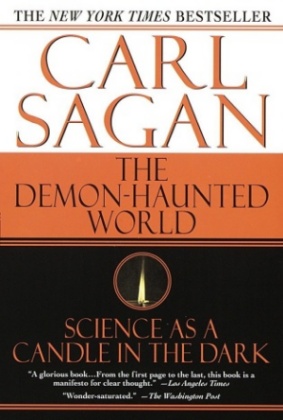
My Thoughts :
The Demon Haunted World is one of those books that you can never forget. It provides the most thought-provoking and comprehensive scrutiny of the disorderly state of our society. The author clearly argues and shows how the rise of pseudoscience and the decline of critical thinking in society are recipes for disaster. From world politics, philosophy, history, economics, religious doctrines, folklore, and the scientific method; Carl Sagan left no stones unturned in this book. This is one of his best offerings to the people of planet earth. For a long time I've been struggling to understand some of the key issues discussed in this book and I'm glad i read it because it provided me with a fresh new perspective.
The baloney-detection toolkit is surely something that should be taught in schools and in higher-education institutions. I think the book deserves to be read by more people on earth. The ideas presented are powerful, simple, and yet essential for the well-being of our society, for a world free of demons.
Details :
- Author : Carl Sagan
- Release Date : 1996
- Publisher : Ballantine Books
Favourite Quotes :
I wish I could tell you about inspirational teachers in science from my elementary or junior high or high school days. But as I think back on it, there were none. There was rote memorization about the Periodic Table of the Elements, levers and inclined planes, green plant photosynthesis, and the difference between anthracite and bituminous coal. But there was no soaring sense of wonder, no hint of an evolutionary perspective, and nothing about mistaken ideas that everybody had once believed. (3 - preface) .. It was our job merely to remember what we had been commanded. Get the right answer, and never mind that you don’t understand what you’re doing. (4 - preface) But as I look back, it seems clear to me that I learned the most essential things not from my school teachers, nor even from my university professors, but from my parents, who knew nothing at all about science, in that single far-off year of 1939. (5 - preface) Mr ‘Buckley’ - well-spoken, intelligent, curious - had heard virtually nothing of modern science. He had a natural appetite for the wonders of the Universe. He wanted to know about science. It’s just that all the science had gotten filtered out before it reached him. Our cultural motifs, our educational system, our communications media had failed this man. What society permitted to trickle through was mainly pretence and confusion. It had never taught him how to distinguish real science from the cheap imitation. He knew nothing about how science works.(8) Maybe Mr Buckley should know to be more sceptical about what’s dished out to him by popular culture. But apart from that, it’s hard to see how it’s his fault. He simply accepted what the most widely available and accessible sources of information claimed was true. For his naivete, he was systematically misled and bamboozled. (9) Hippocrates of Cos is the father of medicine. He is still remembered 2,500 years later for the Hippocratic Oath (a modified form of which is still here and there taken by medical students upon their graduation). But he is chiefly celebrated because of his efforts to bring medicine out of the pall of superstition and into the light of science. In a typical passage Hippocrates wrote: ‘Men think epilepsy divine, merely because they do not understand it. But if they called everything divine which they do not understand, why, there would be no end of divine things.’ Instead of acknowledging that in many areas we are ignorant, we have tended to say things like the Universe is permeated with the ineffable. A God of the Gaps is assigned responsibility for what we do not yet understand. As knowledge of medicine improved since the fourth century BC, there was more and more that we understood and less and less that had to be attributed to divine intervention - either in the causes or in the treatment of disease. Deaths in childbirth and infant mortality have decreased, lifetimes have lengthened, and medicine has improved the quality of life for billions of us all over the planet. (11) Longevity is perhaps the best single measure of the physical quality of life. ---- This is a precious offering from science to humanity -nothing less than the gift of life. (14) Roughly half the scientists on Earth work at least part-time for the military. While a few scientists are still perceived as outsiders, courageously criticizing the ills of society and providing early warnings of potential technological catastrophes, many are seen as compliant opportunists, or as the willing source of corporate profits and weapons of mass destruction - never mind the long-term consequences. The technological perils that science serves up, its implicit challenge to received wisdom, and its perceived difficulty, are all reasons for some people to mistrust and avoid it. There’s a reason people are nervous about science and technology. And so the image of the mad scientist haunts our world - down to the white-coated loonies of Saturday morning children’s TV and the plethora of Faustian bargains in popular culture, from the eponymous Dr Faustus himself to Dr Frankenstein, Dr Strangelove, and Jurassic Park. But we can’t simply conclude that science puts too much power into the hands of morally feeble technologists or corrupt, power-crazed politicians and so decide to get rid of it. Advances in medicine and agriculture have saved vastly more lives than have been lost in all the wars in history. Advances in transportation, communication and entertainment have transformed and unified the world. In opinion poll after opinion poll science is rated among the most admired and trusted occupations, despite the misgivings. The sword of science is double-edged. Its awesome power forces on all of us, including politicians, a new responsibility - more attention to the long-term consequences of technology, a global and transgenerational perspective, an incentive to avoid easy appeals to nationalism and chauvinism. Mistakes are becoming too expensive. (15) It’s disheartening to discover government corruption and incompetence, for example; but it is better not to know about it? Whose interest does ignorance serve? If we humans bear, say, hereditary propensities toward the hatred of strangers, isn’t self-knowledge the only antidote? If we long to believe that the stars rise and set for us, that we are the reason there is a Universe, does science do us a disservice in deflating our conceits? (16) Plainly there is no way back. Like it or not, we are stuck with science. We had better make the best of it. When we finally come to terms with it and fully recognize its beauty and its power, we will find, in spiritual as well as in practical matters, that we have made a bargain strongly in our favour. (17) Pseudoscience is easier to contrive than science, because distracting confrontations with reality – where we cannot control the outcome of the comparison – are more readily avoided. The standards of argument, what passes for evidence, are much more relaxed. In part for these same reasons, it is much easier to present pseudoscience to the general public than science. (17) Pseudoscience speaks to powerful emotional needs that science often leaves unfulfilled. It caters to fantasies about personal powers we lack and long for (like those attributed to comic book superheroes today, and earlier, to the gods). In some of its manifestations, it offers satisfaction of spiritual hungers, cures for disease, promises that death is not the end. It reassures us of our cosmic centrality and importance. (17) If you’ve never heard of science (to say nothing of how it works), you can hardly be aware you’re embracing pseudoscience. You’re simply thinking in one of the ways that humans always have. Religions are often the state-protected nurseries of pseudoscience, although there’s no reason why religions have to play that role. In a way, it’s an artefact from times long gone. In some countries nearly everyone believes in astrology and precognition, including government leaders. But this is not simply drummed into them by religion; it is drawn out of the enveloping culture in which everyone is comfortable with these practices, and affirming testimonials are everywhere. (19) As amusing as some of pseudoscience may seem, as confident as we may be that we would never be so gullible as to be swept up by such a doctrine, we know it’s happening all around us. Transcendental meditation and Aum Shinrikyo seem to have attracted a large number of accomplished people, some with advanced degrees in physics or engineering. These are not doctrines for nitwits. Something else is going on. (23) If we teach only the findings and products of science - no matter how useful and even inspiring they may be - without communicating its critical method, how can the average person possibly distinguish science from pseudoscience? Both then are presented as unsupported assertion. (26) The method of science, as stodgy and grumpy as it may seem, is far more important than the findings of science. (26) When you’re in love, you want to tell the world. (28) science is more than a body of knowledge; it is a way of thinking.(28) The dumbing down of America is most evident in the slow decay of substantive content in the enormously influential media, the 30-second sound bites (now down to 10 seconds or less), lowest common denominator programming, credulous presentations on pseudoscience and superstition, but especially a kind of celebration of ignorance. (28) We’ve arranged a global civilization in which most crucial elements - transportation, communications, and all other industries; agriculture, medicine, education, entertainment, protecting the environment; and even the key democratic institution of voting - profoundly depend on science and technology. We have also arranged things so that almost no one understands science and technology. This is a prescription for disaster. We might get away with it for a while, but sooner or later this combustible mixture of ignorance and power is going to blow up in our faces. (28) One of the reasons for its success is that science has built-in, error-correcting machinery at its very heart. Some may consider this an overbroad characterization, but to me every time we exercise self-criticism, every time we test our ideas against the outside world, we are doing science. When we are self-indulgent and uncritical, when we confuse hopes and facts, we slide into pseudoscience and superstition. (30) The fact that so little of the findings of modern science is prefigured in Scripture to my mind casts further doubt on its divine inspiration. (38) I reject the notion that science is by its nature secretive. Its culture and ethos are, and for very good reason, collective, collaborative and communicative. (55) In the 1990s the tabloid universe is expanding, voraciously gobbling up other media. Newspapers, magazines or television programmes that labour under prissy restraints imposed by what is actually known are outsold by media outlets with less scrupulous standards. We can see this in the new generation of acknowledged tabloid television, and increasingly in what passes for news and information programmes. Such reports persist and proliferate because they sell. And they sell, I think, because there are so many of us who want so badly to be jolted out of our humdrum lives, to rekindle that sense of wonder we remember from childhood, and also, for a few of the stories, to be able, really and truly, to believe in Someone older, smarter and wiser who is looking out for us. Faith is clearly not enough for many people. They crave hard evidence, scientific proof. They long for the scientific seal of approval, but are unwilling to put up with the rigorous standards of evidence that impart credibility to that seal. What a relief it would be: doubt reliably abolished! Then, the irksome burden of looking after ourselves would be lifted. We’re worried - and for good reason -about what it means for the human future if we have only ourselves to rely upon. (59) - as I understood more about that remorseless taskmaster called the scientific method: everything hinges on the matter of evidence. On so important a question, the evidence must be airtight. The more we want it to be true, the more careful we have to be. No witness’s say-so is good enough. People make mistakes. People play practical jokes. People stretch the truth for money or attention or fame. People occasionally misunderstand what they’re seeing. People sometimes even see things that aren’t there. (68) When we notice something strange in the sky, some of us become excitable and uncritical, bad witnesses. (70) Our politics, economics, advertising and religions (New Age and Old) are awash in credulity. Those who have something to sell, those who wish to influence public opinion, those in power, a sceptic might suggest, have a vested interest in discouraging scepticism. (76) What is the common thread that binds these ads together? Not UFOs. Surely it’s the expectation of unlimited audience gullibility. That’s why they’re placed in UFO magazines - because by and large the very act of buying such a magazine so categorizes the reader. (94) [T]he practice of superstition is so congenial to the multitude that, if they are forcibly awakened, they still regret the loss of their pleasing vision. Their love of the marvellous and supernatural, their curiosity with regard to future events, and their strong propensity to extend their hopes and fears beyond the limits of the visible world, were the principal causes which favoured the establishment of Polytheism. So urgent on the vulgar is the necessity of believing, that the fall of any system of mythology will most probably be succeeded by the introduction of some other mode of superstition... (121) the invariable order of Nature, our reason, or at least our imagination, is not sufficiently prepared to sustain the visible action of the Deity. But in the first ages of Christianity the situation of mankind was extremely different. The most curious, or the most credulous, among the pagans were often persuaded to enter into a society which asserted an actual claim of miraculous powers. The primitive Christians perpetually trod on mystic ground, and their minds were exercised by the habits of believing the most extraordinary events. They felt, or they fancied, that on every side they were incessantly assaulted by daemons, comforted by visions, instructed by prophecy, and surprisingly delivered from danger, sickness, and from death itself, by the supplications of the church... (120)sleep, the abbreviation standing for rapid eye movement. (Under the closed eyelids the eyes move, perhaps following the action in the dream, or perhaps randomly.) The REM state is strongly correlated with sexual arousal. Experiments have been performed in which sleeping subjects are awakened whenever the REM state emerges, while members of a control group are awakened just as often each night but not when they’re dreaming. After some days, the control group is a little groggy, but the experimental group – the ones who are prevented from dreaming – is hallucinating in daytime. It’s not that a few people with a particular abnormality can be made to hallucinate in this way; anyone is capable of hallucinations.]"" (99) Whatever their neurological and molecular antecedents, hallucinations feel real. They are sought out in many cultures and considered a sign of spiritual enlightenment. Among the Native Americans of the Western Plains, for example, or many indigenous Siberian cultures, a young man’s future was foreshadowed by the nature of the hallucination he experienced after a successful ‘vision quest’; its meaning was discussed with great seriousness among the elders and shamans of the tribe. There are countless instances in the world’s religions where patriarchs, prophets or saviours repair themselves to desert or mountain and, assisted by hunger and sensory deprivation, encounter gods or demons. (100) Accustomed long since to observe and to respect the invariable order of Nature, our reason, or at least our imagination, is not sufficiently prepared to sustain the visible action of the Deity. But in the first ages of Christianity the situation of mankind was extremely different. The most curious, or the most credulous, among the pagans were often persuaded to enter into a society which asserted an actual claim of miraculous powers. The primitive Christians perpetually trod on mystic ground, and their minds were exercised by the habits of believing the most extraordinary events. They felt, or they fancied, that on every side they were incessantly assaulted by daemons, comforted by visions, instructed by prophecy, and surprisingly delivered from danger, sickness, and from death itself, by the supplications of the church...(120) [T]he practice of superstition is socongenial to the multitude that, if they are forcibly awakened, they still regret the loss of their pleasing vision. Their love of the marvellous and supernatural, their curiosity with regard to future events, and their strong propensity to extend their hopes and fears beyond the limits of the visible world, were the principal causes which favoured the establishment of Polytheism. So urgent on the vulgar is the necessity of believing, that the fall of any system of mythology will most probably be succeeded by the introduction of some other mode of superstition...(121) Perhaps when everyone knows that gods come down to Earth, we hallucinate gods; when all of us are familiar with demons, it’s incubi and succubi; when fairies are widely accepted, we see fairies; in an age of spiritualism, we encounter spirits; and when the old myths fade and we begin thinking that extraterrestrial beings are plausible, then that’s where our hypnogogic imagery tends. (125) The believers take the common elements in their stories as tokens of verisimilitude, rather than as evidence that they have contrived their stories out of a shared culture and biology. (128) And if indeed somewhere, somehow we must eventually draw the line and conclude that some dreams are invented by the dreamer, why not all? (141) It is a capital mistake to theorize before one has data. Insensibly one begins to twist facts to suit theories, instead of theories to suit facts. Sherlock Holmes, in Arthur Conan Doyle’s A Scandal in Bohemia (1891) (143) ... For some people satanism is any religious belief system other than their own Lanning, The police chief, published 1989 (150) Within the personal religious belief system of a law enforcement officer, Christianity may be good and satanism evil. Under the Constitution, however, both are neutral. This is an important, but difficult, concept for many law enforcement officers to accept. They are paid to uphold the penal code, not the Ten Commandments... The fact is that far more crime and child abuse has been committed by zealots in the name of God, Jesus and Mohammed than has ever been committed in the name of Satan. Many people don’t like that statement, but few can argue with it. (150) If we fail to cope, if we’re saddled with a burden of guilt for not having made more of ourselves, wouldn’t we welcome the professional opinion of a therapist with a diploma on the wall that it’s not our fault, that we’re off the hook, that satanists, or sexual abusers, or aliens from another planet are the responsible parties? Wouldn’t we be willing to pay good money for this reassurance? And wouldn’t we resist smart-ass sceptics telling us that it’s all in our heads, or that it’s implanted by the very therapists who have made us happier about ourselves? (156) Now, what’s the difference between an invisible, incorporeal, floating dragon who spits heatless fire and no dragon at all? If there’s no way to disprove my contention, no conceivable experiment that would count against it, what does it mean to say that my dragon exists? Your inability to invalidate my hypothesis is not at all the same thing as proving it true. Claims that cannot be tested, assertions immune to disproof are veridically worthless, whatever value they may have in inspiring us or in exciting our sense of wonder. What I’m asking you to do comes down to believing, in the absence of evidence, on my say-so. (161) Special cautions are necessary when the stakes are high. We are not obliged to make up our minds before the evidence is in. It’s permitted not to be sure. (170) The last words I found myself saying to my father, at the moment of his death,were ‘Take care’. (189) Commercial culture is full of similar misdirections and evasions at the expense of the consumer. You’re not supposed to ask. Don’t think. Buy. (195) You might think that before they denounce unwelcome research findings, major corporations would devote their considerable resources to checking out the safety of the products they propose to manufacture. And if they missed something, if independent scientists suggest a hazard, why would the companies protest? Would they rather kill people than lose profits? If, in an uncertain world, an error must be made, shouldn’t it be biased toward protecting customers and the public? And, incidentally, what do these cases say about the ability of the free enterprise system to police itself? Aren’t these instances where government intrusion is in the public interest? (205) The exposure of fraud and error in faith-healing is almost never done by other faith-healers. Indeed, it is striking how reluctant the churches and synagogues are in condemning demonstrable deception in their midst. (217) Because the intellectual currency has been so debased, because credulity, New Age and Old, is so rampant, because sceptical thinking is so rarely practised, no parody is too implausible. (225) One of the saddest lessons of history is this: if we’ve been bamboozled long enough, we tend to reject any evidence of the bamboozle. We’re no longer interested in finding out the truth. The bamboozle has captured us. It’s simply too painful to acknowledge, even to ourselves, that we’ve been taken. Once you give a charlatan power over you, you almost never get it back. So the old bamboozles tend to persist as the new ones rise. (230) We don’t have to understand the theory to see what it predicts. We don’t have to be accomplished physicists to read what the experiments reveal. (238) Yes, the Darwinian insight can be turned upside down and grotesquely misused: voracious robber barons may explain their cut-throat practices by an appeal to Social Darwinism; Nazis and other racists may call on ‘survival of the fittest’ to justify genocide. But Darwin did not make John D. Rockefeller or Adolf Hitler. Greed, the Industrial Revolution, the free enterprise system, and corruption of government by the monied are adequate to explain nineteenth-century capitalism. Ethnocentrism, xenophobia, social hierarchies, the long history of anti-Semitism in Germany, the Versailles Treaty, German child-rearing practices, inflation and the Depression seem adequate to explain Hitler’s rise to power. (249) modern Darwinism makes it abundantly clear that many less ruthless traits, some not always admired by robber barons and Fiihrers -- altruism, general intelligence, compassion - may be the key to survival. (249) [I]gnorance more frequently begets confidence than does knowledge: it is those who know little, and not those who know much, who so positively assert that this or that problem will never be solved by science. Charles Darwin, Introduction, The Descent of Man (1871) All the mammals - and many other animals as well - experience emotions: fear, lust, hope, pain, love, hate, the need to be led. Humans may brood about the future more, but there is nothing in our emotions unique to us. On the other hand, no other species does science as much or as well as we. How then can science be ‘dehumanizing’? (255) Still, it seems so unfair: some of us starve to death before we’re out of infancy, while others - by an accident of birth - live out their lives in opulence and splendour. We can be born into an abusive family or a reviled ethnic group, or start out with some deformity; we go through life with the deck stacked against us, and then we die, and that’s it? Nothing but a dreamless and endless sleep? Where’s the justice in this? This is stark-and brutal and heartless. Shouldn’t we have a second chance on a level playing field? How much better if we were born again in circumstances that took account of how well we played our part in the last life, no matter how stacked against us the deck was then. Or if there were a time of judgement after we die, then - so long as we did well with the persona we were given in this life, and were humble and faithful and all the rest - we should be rewarded by living joyfully until the end of time in a permanent refuge from the agony and turmoil of the world. That’s how it would be if the world were thought out, preplanned, fair. That’s how it would be if those suffering from pain and torment were to receive the consolation they deserve. (255) So societies that teach contentment with our present station in life, in expectation of post mortem reward, tend to inoculate themselves against revolution. Further, fear of death, which in some respects is adaptive in the evolutionary struggle for existence, is maladaptive in warfare. Those cultures that teach an afterlife of bliss for heroes - or even for those who just did what those in authority told them - might gain a competitive advantage. (255) Sometimes scientists are castigated for doing evil, and sometimes for warning about the evil uses to which science may be put. (267) It is properly said that the Devil can ‘quote Scripture to his purpose’. The Bible is full of so many stories of contradictory moral purpose that every generation can find scriptural justification for nearly any action it proposes, from incest, slavery and mass murder to the most refined love, courage and self-sacrifice. And this moral multiple personality disorder is hardly restricted to Judaism and Christianity. You can find it deep within Islam, the Hindu tradition, indeed nearly all the world’s religions. Perhaps then it is not so much scientists as people who are morally ambiguous. (276) Among the IKung San hunter-gatherers of the Kalahari Desert, when two men, perhaps testosterone-inflamed, would begin to argue, the women would reach for their poison arrows and put the weapons out of harm’s way. Today our poison arrows can destroy the global civilization and just possibly annihilate our species. The price of moral ambiguity is now too high. For this reason - and not because of its approach to knowledge - the ethical responsibility of scientists must also be high, extraordinarily high, unprecedent-edly high. I wish graduate science programmes explicitly and systematically raised these questions with fledgling scientists and engineers. And sometimes I wonder whether in our society, too, the women - and the children - will eventually put the poison arrows out of harm’s way. (276) And yet, the chief deficiency I see in the sceptical movement is in its polarization: Us v. Them - the sense that we have a monopoly on the truth; that those other people who believe in all these stupid doctrines are morons; that if you’re sensible, you’ll listen to us; and if not, you’re beyond redemption. This is unconstructive. It does not get the message across. It condemns the sceptics to permanent minority status; whereas, a compassionate approach that from the beginning acknowledges the human roots of pseudoscience and superstition might be much more widely accepted. (282) Why fear a little criticism? Aren’t they interested to see how well their beliefs hold up against the best counterarguments the sceptics can muster? (284) The collective enterprise of creative thinking and sceptical thinking, working together, keeps the field on track. (287) If you’re only sceptical, then no new ideas make it through to you. You never learn anything. You become a crochety misanthrope convinced that nonsense is ruling the world. (There is, of course, much data to support you.) (287) Because of this dogged mutual and self-criticism, and the proper reliance on experiment as the arbiter between contending hypotheses, many scientists tend to be diffident about describing their own sense of wonder at the dawning of a wild surmise. This is a pity, because these rare exultant moments demystify and humanize the scientific endeavour. (287) The enormous zest for science that I see in first-graders and the lesson from the remnant hunter-gatherers both speak eloquently: a proclivity for science is embedded deeply within us, in all times, places and cultures. It has been the means for our survival. It is our birthright. (299) So we keep asking, over and over, Until a handful of earth Stops our mouths— But is that an answer? Heinrich Heine, ‘Lazarus’ (1854) [300] Every now and then, I’m lucky enough to teach a kindergarten or first-grade class. Many of these children are natural-born scientists - although heavy on the wonder side and light on scepticism. They’re curious, intellectually vigorous. Provocative and insightful questions bubble out of them. They exhibit enormous enthusiasm. I’m asked follow-up questions. They’ve never heard of the notion of a ‘dumb question’. But when I talk to high school seniors, Ifind something different. They memorize ‘facts’. By and large, though, the joy of discovery, the life behind those facts, has gone out of them. They’ve lost much of the wonder, and gained very little scepticism. They’re worried about asking ‘dumb’ questions; they’re willing to accept inadequate answers; they don’t pose follow-up questions; the room is awash with sidelong glances to judge, second-by-second, the approval of their peers. They come to class with their questions written out on pieces of paper, which they surreptitiously examine, waiting their turn and oblivious of whatever discussion their peers are at this moment engaged in. Something has happened between first and twelfth grade, and it’s not just puberty. (301) But here I’m concerned not with producing a new generation of first-rate scientists and mathematicians, but a scientifically literate public. (304) There was a most revealing rule: slaves were to remain illiterate. In the antebellum South, whites who taught a slave to read were severely punished. ‘[To] make a contented slave,’ Bailey later wrote, ‘it is necessary to make a thoughtless one. It is necessary to darken his moral and mental vision, and, as far as possible, to annihilate the power of reason.’ This is why the slaveholders must control what slaves hear and see and think. This is why reading and critical thinking are dangerous, indeed subversive, in an unjust society. (334) Books changed all that. Books, purchasable at low cost, permit us to interrogate the past with high accuracy; to tap the wisdom of our species; to understand the point of view of others, and not just those in power; to contemplate - with the best teachers - the insights, painfully extracted from Nature, of the greatest minds that ever were, drawn from the entire planet and from all of our history. They allow people long dead to talk inside our heads. Books can accompany us everywhere. Books are patient where we are slow to understand, allow us to go over the hard parts as many times as we wish, and are never critical of our lapses. Books are key to understanding the world and participating in a democratic society. (336) The gears of poverty, ignorance, hopelessness and low self-esteem mesh to create a kind of perpetual failure machine that grinds down dreams from generation to generation. We all bear the cost of keeping it running. Illiteracy is its linchpin. (341) So what data were they missing, all those famous male scientists of the 1950s and 1960s and earlier who had pronounced so authoritatively on the intellectual deficiencies of women? Plainly, society was preventing women from entering science, and then criticizing them for it, confusing cause and effect: (356) The equations were to represent Nature, and Nature is, Maxwell believed, beautiful and elegant. -- This essentially aesthetic judgement by a nerdish physicist, entirely unknown except to a few other academic scientists, has done more to shape our civilization than any ten recent presidents and prime ministers. (364) And far from being too expensive, the programme would have cost about one attack helicopter per year. (371) Cutting off fundamental, curiosity-driven science is like eating the seed corn. We may have a little more to eat next winter, but what will we plant so we and our children will have enough to get through the winters to come? (376) The unprecedented powers that science now makes available must be accompanied by unprecedented levels of ethical focus and concern by the scientific community, as well as the most broadly based public education into the importance of science and democracy. (395) It is not the function of our government to keep the citizen from falling into error; it is the function of the citizen to keep the government from falling into error. US Supreme Court Justice Robert H. Jackson, 1950 (396) Even a casual scrutiny of history reveals that we humans have a sad tendency to make the same mistakes again and again. We’re afraid of strangers or anybody who’s a little different from us. When we get scared, we start pushing people around. We have readily accessible buttons that release powerful emotions when pressed. We can be manipulated into utter senselessness by clever politicians. Give us the right kind of leader and, like the most suggestible subjects of the hypnotherapists, we’ll gladly do just about anything he wants - even things we know to be wrong. The framers of the Constitution were students of history. In recognition of the human condition, they sought to invent a means that would keep us free in spite of ourselves. (397) History taught him that the rich and powerful will steal and oppress if given half a chance.(400) Once you questioned the religious insistence on the prevailing view that the Earth was at the centre of the Universe, why should you accept the repeated and confident assertions by religious leaders that God sent kings to rule over us? (405) If we can’t think for ourselves, if we’re unwilling to question authority, then we’re just putty in the hands of those in power. But if the citizens are educated and form their own opinions, then those in power work for us. (408)Read : 18 Sept 2022 - 15 Oct 2022