


Comet
My Thoughts :
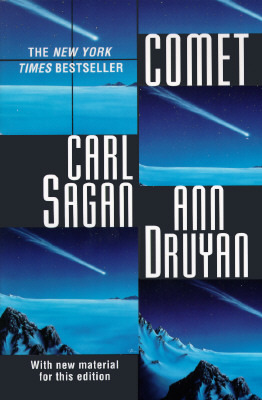
I previously did not think much of comets but that all changed when i read this book. I now realize that they are one of the most spectacular celestial objects in our night sky. This book covers everything about comets; their origins, what they are made of, how ancient civilizations saw them, the myths, fears, and stories they told. It goes all the way through history and different cultures to the modern scientific understanding of comets. It also the covers the stories of notable figures and scientists who made valuable contributions to the study of comets such as Isaac Newton and Edmond Halley. The last part of the book reflects on the evolution of our species and shows what role the comets have played for us to get here and what the future implications might be. Overall, the book is a must-read for anyone who wants to know more about these majestic celestial bodies called comets.
Details :
- Author : Carl Sagan, Ann Druyan
- Release Date : 1985
- Publisher : Ballantine Books
Favourite Quotes :
The long and lovely tails now precede you on your journey; the wind from the Sun is at your back. (24) it was in Greece in the fifth century B.C. that curiosity turned away from the supernatural, and first found its world-changing means of expression: science.(34) Many things that are unknown to us the people of a coming age will know. Many discoveries are reserved for ages still to come.… Nature does not reveal her mysteries once and for all. We believe we are her initiates, but we are only hanging around the forecourt. - Seneca - Natural questions, Comets (38) "Place your finger in front of your nose and alternately wink your left and right eyes. You will see the finger seem to move against the more distant landscape. Now move the finger to arm’s length and wink again. The finger still moves, but less so. The apparent motion is called parallax; it is merely the change in perspective from left eye to right. The closer the finger is to you, the more parallax or apparent motion against the background; the further the finger is from you, the smaller is the parallax. "(46) Halley’s conduct had been a model of fairness and candor, risking the displeasure of powerful friends in the interest of truth. (59) There is a widely held belief that the price of deeply understanding the complexities of nature is paid out in the currency of alienation. Something like an inverse square law exists, it is said, between scientific genius and the capacity for love. If the life of Isaac Newton is pointed to as the most dramatic illustration of this theorem, then the life of his friend Edmond Halley, who more than anyone else made manifest Newton’s genius, may be offered as its most inspiring exception. (89) Nature is thus sufficient for itself; the Divine government is unnecessary.… Emmanuel Kant (103) The density of liquid water is 1.0 grams per cubic centimeter, but the density of ordinary ice is 0.92 grams per cubic centimeter, a circumstance otherwise virtually unknown in nature. For other substances, the solid is almost always more dense than the liquid and promptly sinks. Floating icebergs and ice-covered rivers will be unheard of on planets where the dominant liquids are ammonia, say, or hydrocarbons such as methane. (139) The Earth and the other planets tend to be almost perfect spheres because, as Newton showed, gravity is a central force—it pulls everything equally toward the center of the world, itself held together by the force of gravity. (154) Since the material in the coma and tail is never recaptured by the comet, it gradually dwindles, successive layers are peeled off and lost to space, and its interior parts are exposed to view. One way or another, every comet we see is dying. (158) In a prescientific, preliterate society, accounts of an unprecedented occurrence involving uncommon physics must necessarily, after thousands of years, take on lives of their own. (194) We live at the heart of a trillion worlds, all of them invisible. It sounds like the teaching of some New Age sect. And we are not talking of metaphorical worlds; rather a trillion places, every one of them as distinct a world as ours is, every one gravitationally bound to the Sun, every one with a surface and an interior and on occasion even an atmosphere. (209) If you look at the planets today you find them decorously spaced, their orbits by and large almost perfectly circular; except for the case of Pluto,..* (237) * And for this reason some scientists have supposed that Pluto is an escaped satellite from Neptune, returning periodically to the scene of the crime. Every comet as it dies litters its orbit with debris. Some orbits cross the Earth’s. Meteor showers are the ghosts of comets past and passing.(250) Extinction is the rule. Survival is the exception. (292) For over 100 million years our ancestors were at an apparent evolutionary cul de sac, living at the margins and in the shadows of a world dominated by dinosaurs. If you surveyed that late Cretaceous landscape—in which the trees and flowers looked pretty much as they do today, but where the dominant animals were all reptiles—you would not have bet much on the chances of our ancestors. But the dinosaurs went and died, every last one of them, and left the planet to the mammals.... (296) "In those times of ignorance, mankind were far from thinking that the only mode of questioning nature is by calculation and observation: According as phenomena succeeded with regularity or without apparent order, they were supposed to depend either on final causes or on chance; and whenever any happened which seemed out of the natural order, they were considered as so many signs of the wrath of heaven. But these imaginary causes have successively given way to the progress of knowledge, and will totally disappear in the presence of sound philosophy, which sees nothing in them, but expressions of the ignorance of the truth." Laplace (297) "Nevertheless, the small probability of this circumstance may, by accumulating during a long succession of ages, become very great. It is easy to represent the effect of such a shock upon the Earth: the axis and motions of rotation changed, the waters abandoning their previous position, to precipitate themselves towards the new equator; the greater part of men and animals drowned in a universal deluge, or destroyed by the violence of the shock given to the terrestrial globe; whole species destroyed; all the monuments of human industry reversed; such are the disasters which a shock of a comet would produce." Laplace (300) But if comets are a kilometer or more across and traveling at great speed in the same part of the solar system as the Earth, it follows that sooner or later a largish comet will indeed strike the Earth, with consequences that we can be sure would be catastrophic, even if we were unable to trace exactly what would happen.(302) A worldwide iridium-rich layer marking the end of the Cretaceous looks very much like direct evidence that a large cosmic body struck the Earth 65 million years ago. (305) Everything you see around you, alive or inanimate, has fallen from the sky—or, at least, the constituent atoms have. There was a time before the Earth was formed, when these atoms were parts of small worlds busily manufacturing planets as they collided. And there was a time before that, when all the atoms in and around you, every one of them, were in gas and microscopic grains floating in interstellar space. After the Earth was fully formed, more cosmic matter, chiefly from comets, glued itself to the Earth’s surface. Everything on Earth is sky stuff—collected, for a while at least, on this lump of metal, rock, and water. (329) The comets may seem remote to the point of myth or fable; but, in fact, they have a most lucid reality—they are a part of our planet and ourselves. (332) But the proposals were turned down by Democratic and Republican administrations both. There was not enough money. The United States had more important things to do. The cost of a major mission to Comet Halley was roughly that of a single B-1 bomber. The United States was committed to 100 B-1 bombers. We couldn’t have gotten by with 99. (353) Certainly all the molecular necessities of life are to be found on comets. Humans, like most other lifeforms on Earth, are made largely of water, and except possibly for a few of the moons in the outer solar system, there are no known worlds richer in water than the comets. Comets also contain large quantities of organic molecules, useful for agriculture and biological engineering, and rock and metal probably sufficient for practical purposes. The great quantities of water also mean that oxygen for breathing should be easily extractable... . In each of these respects comets are much more obliging bases and habitats than, say, the rocky and metallic asteroids. (369) Comets (and icy boulders from the rings of Saturn) can be driven or towed to the inner solar system, where the ice would be mined directly from the surface or, for nearby extinct comets, by drilling through the lag deposit to the icy core below. The water would be dissociated to make rocket fuel and oxidant, and to supply oxygen to human outposts in space and on the other terrestrial planets. There is so much water available from comets that it is even possible to imagine water provided to selected regions of parched worlds, permitting life to be transplanted to previously desolate environments. (370) It is a law of biology as well as of social relations that isolation fosters diversity. (373) Contemplated as one grand whole, astronomy is the most beautiful monument of the human mind; the noblest record of its intelligence. Seduced by the illusions of the senses, and of self-love, man considered himself, for a long time, as the centre of the motion of the celestial bodies, and his pride was justly punished by the vain terrors they inspired. The labour of many ages has at length withdrawn the veil which covered the system. Man appears, upon a small planet, almost imperceptible in the vast extent of the solar system, itself only an insensible point in the immensity of space. The sublime results to which this discovery has led may console him for the limited place assigned him in the universe. —PIERRE SIMON, MARQUIS DE LAPLACE,SYSTEM OF THE WORLD, PART 1, CHAPTER 6, 1796 (381) Halley’s Comet is a kind of metronome beating out the rhythm of human progress or decline. Its 1910 apparition was the first since the invention of the airplane and the last before nuclear weapons. We have lately arranged the means of our self-destruction, and there is a real question of how many humans will be left the next time Halley’s Comet comes by the Earth, in July 2061 (385) When the rest of the solar system is dead, and the descendants of humans long ago emigrated or extinct, the comets will still be here. (387) It was clear and frosty. Above the dirty, ill-lit streets, above the black roofs, stretched the dark starry sky. Only looking up at the sky did Pierre cease to feel how sordid and humiliating were all mundane things compared with the heights to which his soul had just been raised. At the entrance to the Arbat Square an immense expanse of dark starry sky presented itself to his eyes. LEO TOLSTOY, WAR AND PEACE, VIII, 22 (388)Read : 27 May 2022 - 01 June 2022