


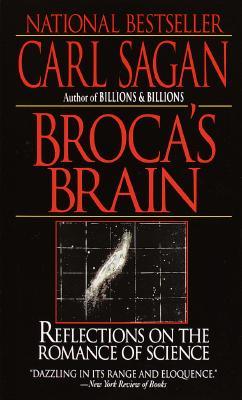
Broca's Brain: Reflections on the Romance of Science
My Thoughts :
The first part of the book is a masterpiece and it was fascinating to learn more about the brains of world-renowned scientists such as Albert Einstein and Paul Broca. For me the best part was when Carl was holding the preserved brain of Broca in his hands and pondering if some part of him was still alive in there. There is also a brilliant chapter where the author demonstrates the amount of information packed in a grain of sand and makes an analogy with the amount of information perceivable by the human brain. I am not sure just how accurate his approximations were or if some of them are now outdated but the chapter was written so eloquently that it really makes you wonder just how much in everyday life we overlook the intricacy of the world we live in. However, besides the chapters in part 1, the rest of the book is a bit dull and not very interesting except for a few chapters here and there. Most of the information and arguments presented in part 2 and part 3 of the book i have already heard from other books by Carl Sagan so i ended up skimming/skipping those chapters.
Details :
- Author : Carl Sagan
- Release Date : 1979
- Publisher : Ballantine Books
Favourite Quotes :
There is a lurking fear, made explicit in the Faust legend, that some things are not “meant” to be known, that some inquiries are too dangerous for human beings to make. And in our own age, the development of nuclear weapons may, if we are unlucky or unwise, turn out to be a case of precisely this sort. But in the case of experiments on the brain, our fears are less intellectual. (30) The best way to avoid abuses is for the populace in general to be scientifically literate, to understand the implications of such investigations. In exchange for freedom of inquiry, scientists are obliged to explain their work. If science is considered a closed priesthood, too difficult and arcane for the average person to understand, the dangers of abuse are greater. But if science is a topic of general interest and concern—if both its delights and its social consequences are discussed regularly and competently in the schools, the press, and at the dinner table—we have greatly improved our prospects for learning how the world really is and for improving both it and us. (31) SCIENCE IS A WAY of thinking much more than it is a body of knowledge (33) Our intuition is by no means an infallible guide. Our perceptions may be distorted by training and prejudice or merely because of the limitations of our sense organs, which, of course, perceive directly but a small fraction of the phenomena of the world. (33) We are an intelligent species and the use of our intelligence quite properly gives us pleasure. In this respect the brain is like a muscle. When we think well, we feel good. Understanding is a kind of ecstasy. (35) If the universe had natural laws that governed its behavior to the same degree of regularity that determines a crystal of salt, then, of course, the universe would be knowable. Even if there were many such laws, each of considerable complexity, human beings might have the capability to understand them all. Even if such knowledge exceeded the information-carrying capacity of the brain, we might store the additional information outside our bodies—in books, for example, or in computer memories—and still, in some sense, know the universe. (37) Those creatures who find everyday experience a muddled jumble of events with no predictability, no regularity, are in grave peril.(37) For myself, I like a universe that includes much that is unknown and, at the same time, much that is knowable. A universe in which everything is known would be static and dull, as boring as the heaven of some weakminded theologians. (39) The cultivation of the mind is a kind of foodsupplied for the soul of man. MARCUS TULLIUS CICERO,De Finibus Bonorum et Malorum,Vol. 19 (45–44 B.C.) (61) Aristotle’s view was of God as an unmoved prime mover, a roi fainéant, a do-nothing king who establishes the universe in the first place and then sits back and watches the intricate, intertwined chains of causality course down through the ages. (416) We are thinking beings. Our minds are our distinguishing characteristic as a species. We are not stronger or swifter than many other animals that share this planet with us. We are only smarter. (69) No one can predict where the future leaders of science will come from. It is clear that Albert Einstein became a scientist in spite of, not because of, his schooling. (70) We are at a crossroads in human history. Never before has there been a moment so simultaneously perilous and promising. We are the first species to have taken our evolution into our own hands. For the first time we possess the means for intentional or inadvertent self-destruction. We also have, I believe, the means for passing through this stage of technological adolescence into a long-lived, rich and fulfilling maturity for all the members of our species. (71) What is wanted is not the will to believe,but the wish to find out, which isthe exact opposite. BERTRAND RUSSELL,Sceptical Essays (1928) (76) Many of the people who ask whether I believe in God are requesting reassurance that their particular belief system, whatever it is, is consistent with modern scientific knowledge. ,(417) The fact that religions can be so shamelessly dishonest, so contemptuous of the intelligence of their adherents, and still flourish does not speak very well for the tough-mindedness of the believers. But it does indicate, if a demonstration were needed, that near the core of the religious experience is something remarkably resistant to rational inquiry (417) We can understand why the oligarchy might favor religion when, as is often the case, religion justifies oppression—as Plato, a dedicated advocate of book-burning, did in the Republic. But why do the oppressed so eagerly go along with these theocratic doctrines? (449) To be certain of the existence of God and to be certain of the nonexistence of God seem to me to be the confident extremes in a subject so riddled with doubt and uncertainty as to inspire very little confidence indeed. (451)Finished reading : 27 May 2022