


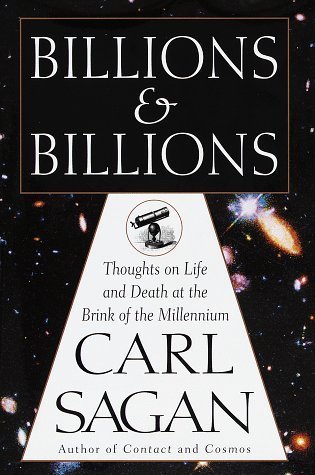
Billions & Billions: Thoughts on Life and Death at the Brink of the Millennium
My Thoughts :
Details :
- Author : Carl Sagan, Ann Druyan
- Release Date : 1998
- Publisher : Ballantine Books
Favourite Quotes :
Never underestimate an exponential. [19] If you know a thing only qualitatively, you know it no more than vaguely. If you know it quantitatively—grasping some numerical measure that distinguishes it from an infinite number of other possibilities—you are beginning to know it deeply. You comprehend some of its beauty and you gain access to its power and the understanding it provides. Being afraid of quantification is tantamount to disenfranchising yourself, giving up on one of the most potent prospects for understanding and changing the world. [27] There are sports stars who make 50 times the annual salary of the President; some who are themselves, after retirement, elected to high office. They are national heroes. Why, exactly? There is something here transcending the diversity of political, social, and economic systems. Something ancient is calling. [28] Ethnocentrism—the idea that our little group, no matter which one it is, is better than any other—and xenophobia—a "shoot first, ask questions later" fear of strangers—are deeply built into us. They are by no means peculiarly human; all our monkey and ape cousins behave similarly, as do many other mammals. These attitudes are at least aided and abetted by the short distances over which speech is possible. If we're isolated for long periods from those other guys, we and they slowly develop in different directions. Their warriors start wearing ocelot skins, for example, instead of eagle feather headdresses—which everybody around here knows are fashionable, proper, and sane. Their language eventually becomes different from ours, their gods have strange names and demand bizarre ceremonies and sacrifices. Isolation breeds diversity; and our small numbers and limited communications range guarantee isolation. The human family—originating in one small locale in East Africa a few million years ago—wandered, separated, diversified, and became strangers to one another. [43] This wave-particle dualism is another reminder of a central humbling fact: Nature does not always conform to our predispositions and preferences, to what we deem comfortable and easy to understand. [45] Prophecy is a lost art. Despite our "eager desire to pierce the thick darkness of futurity," in Charles McKay's words, we're often not very good at it. In science the most important discoveries are often the most unexpected—not a mere extrapolation from what we currently know, but something completely different. The reason is that Nature is far more inventive, subtle, and elegant than humans are. So in a way it's foolish to attempt to anticipate what the most significant findings in astronomy might be in the next few decades, the future adumbration of our creation myth. But on the other hand, there are discernible trends in the development of new instrumentation that indicate at least the prospect of goosebump-raising new discoveries. [ 57] If extraterrestrial intelligence is found, then our view of the Universe and ourselves is changed forever. And if after a long and systematic search we find nothing, then we may have calibrated something of the rarity and preciousness of life on Earth. Either way, this is a search well worth doing. [62] These are deep and difficult questions which every human culture has one way or another tried to grapple with. But only in our time do we have a real prospect of uncovering some of the answers. Not by guesses or stories—but by real, repeatable, verifiable observations. [63] But we humans are newcomers, arising only a few million years ago. Our present technical civilization is just a few hundred years old. We have not had much recent experience in voluntary interspecies (or even intraspecies) cooperation. We are very devoted to the short-term and hardly ever think about the long-term. There is no guarantee that we will be wise enough to understand our planetwide closed ecological system, or to modify our behavior in accord with that understanding. [ 80] Our technology has become so powerful that—not only consciously, but also inadvertently—we are becoming a danger to ourselves. Science and technology have saved billions of lives, improved the well-being of many more, bound up the planet in a slowly anastomosing unity—and at the same time changed the world so much that many people no longer feel at home in it. We've created a range of new evils: hard to see, hard to understand, problems that cannot readily be cured—certainly not without challenging those already in power. [85] This sort of contemplating the future consequences of present actions has a proud lineage among us primates, and is one of the secrets of what is still, by and large, the stunningly successful story of humans on Earth. [91] Venus is a practical demonstration that an increase in the abundance of greenhouse gases may have unpleasant consequences. It is a good place to point ideologically driven radio talk-show hosts who insist that the greenhouse effect is a "hoax." [124] In any case, it's pretty clear that the faster the climate is changing, the more difficult it is for whatever homeostatic systems there are to catch up and stabilize. I wonder if we're not more likely to miss unpleasant feedbacks than comforting ones. We're not smart enough to predict everything. That's certainly clear. I think it's unlikely that the sum of what we're too ignorant to figure out will save us. Maybe it will. But would we want to bet our lives on it? [138] The rewards for finding that there is no ozone depletion or that global warming is insignificant are very high. There are many powerful and wealthy industries and individuals that would benefit if only such contentions were true. But as the programs of scientific meetings indicate, this is probably a forlorn hope. [ 139] The principal obstacle is, of course, inertia, resistance to change—huge, worldwide, interlocking industrial, economic, and political establishments all beholden to fossil fuels, when fossil fuels are the problem. In the United States, as the evidence for the seriousness of global warming mounts, the political will to do something about it seems to be shriveling. [139] For many reasons, developing countries are particularly vulnerable to global warming. They are less able to adapt to new climates, adopt new crops, reforest, build seawalls, accommodate to drought and floods. At the same time they are especially dependent on fossil fuels. What is more natural than for China, say—with the world's second largest coal reserves—to rely on fossil fuels during its exponential industrialization? And if emissaries from Japan, Western Europe, and the United States were to go to Beijing and ask for restraint in the burning of coal and oil, wouldn't China point out that these nations did not exercise such restraint during their industrialization? (And anyway the 1992 Rio Framework Convention on Climate Change, ratified by 150 countries, calls for developed countries to pay the cost of limiting greenhouse gas emissions in developing countries.) Developing countries need an inexpensive, comparatively low-technology alternative to fossil fuels. [152] Solar-powered cars have already competed in long-distance races. Solar power could be used for generating hydrogen fuel from water; when burned, the hydrogen simply regenerates water. There's a great deal of desert in the world that might be gainfully employed in an ecologically responsible way, for harvesting sunlight. Solar-electric or "photovoltaic" energy has been routinely used for decades to power spacecraft in the vicinity of the Earth and through the inner Solar System. Photons of light strike the cell's surface and eject electrons, whose cumulative flow is a current of electricity. These are practical, extant technologies. [155] Nevertheless, there are some encouraging signs. American-made small-scale solar-electric devices are beginning to dominate the world market. (Of the three largest companies, two are controlled by Germany and Japan; the third, by U.S. fossil fuel corporations.) Tibetan herders are using solar panels to power light bulbs and radios; Somalian physicians erect solar panels on camels to keep precious vaccines cold in their trek across the desert; 50,000 small homes in India are being converted to solar-electric power. Because these systems are within the reach of the lower middle class in developing countries, and because they are nearly maintenance free, the potential market in solar rural electrification is huge. [157] We can and should be doing better. There should be massive federal commitment to advance this technology, and incentives offered to scientists and inventors to enter this underpopulated field. Why is "energy independence" mentioned so often as a justification for environmentally risky nuclear power plants or offshore drilling—but so rarely to justify insulation, efficient cars, or wind and solar energy? Many of these new technologies can also be used in the developing world to improve industry and standards of living without making the environmental mistakes of the developed world. [157] Our ancestors came from the trees, and we have a natural affinity for them. It is perfectly appropriate for us to plant more. [159] We cannot safely continue mindless growth in technology, and wholesale negligence about the consequences of that technology. It is well within our power to guide technology, to direct it to the benefit of everyone on Earth. Perhaps there is a kind of silver lining to these global environmental problems, because they are forcing us, willy-nilly, no matter how reluctant we may be, into a new kind of thinking—in which in some matters the well-being of the human species takes precedence over national and corporate interests. We are a resourceful species when push conies to shove. We know what to do. Out of the environmental crises of our time should come, unless we are much more foolish than I think we are, a binding up of the nations and the generations, and even the end of our long childhood. [162] The first day or so, we all pointed to our countries. The third or fourth day, we were pointing to our continents. By the fifth day, we were aware of only one Earth. PRINCE SULTAN BIN SALMON AL-SAUD, Saudi Arabian astronaut [163] The methods and ethos of science and religion are profoundly different. Religion frequently asks us to believe without question, even (or especially) in the absence of hard evidence. Indeed, this is the central meaning of faith. Science asks us to take nothing on faith, to be wary of our penchant for self-deception, to reject anecdotal evidence. Science considers deep skepticism a prime virtue. Religion often sees it as a barrier to enlightenment. So, for centuries, there has been a conflict between the two fields—the discoveries of science challenging religious dogmas, and religion attempting to ignore or suppress the disquieting findings. [166] Science and religion may differ about how the Earth was made, but we can agree that protecting it merits our profound attention and loving care. [172] For many Americans, communism means poverty, backwardness, the Gulag for speaking one's mind, a ruthless crushing of the human spirit, and a thirst to conquer the world. For many Soviets, capitalism means heartless and insatiable greed, racism, war, economic instability, and a worldwide conspiracy of the rich against the poor. These are caricatures—but not wholly so—and over the years Soviet and American actions have given them some credence and plausibility. [188] Bureaucrats have motives for inventing enemies and exaggerating their misdeeds [189] Each nation has military and intelligence establishments that evaluate the danger posed by the other side. These establishments have a vested interest in large military and intelligence expenditures. Thus, they must grapple with a continuing crisis of conscience—the clear incentive to exaggerate the adversary's capabilities and intentions. When they succumb, they call it necessary prudence; but whatever they call it, it propels the arms race. Is there an independent public assessment of the intelligence data? No. Why not? Because the data are secret. So we have here a machine that goes by itself, a kind of de facto conspiracy to prevent tensions from falling below a minimum level of bureaucratic acceptability. [189] A central lesson of science is that to understand complex issues (or even simple ones), we must try to free our minds of dogma and to guarantee the freedom to publish, to contradict, and to experiment. Arguments from authority are unacceptable. [189] Mankind likes to think in terms of extreme opposites. It is given to formulating its beliefs in terms of Either- Ors, between which it recognizes no intermediate possibilities. When forced to recognize that the extremes cannot be acted upon, it is still inclined to hold that they are all right in theory, but that when it comes to practical matters circumstances compel us to compromise. JOHN DEWEY, Experience and Education, I (1938) [196] Moral codes that seek to regulate human behavior have been with us not only since the dawn of civilization but also among our pre-civilized, and highly social, hunter-gatherer ancestors. And even earlier. Different societies have different codes. Many cultures say one thing and do another. In a few fortunate societies, an inspired lawgiver lays down a set of rules to live by (and more often than not claims to have been instructed by a god—without which few would follow the prescriptions). For example, the codes of Ashoka (India), Hammurabi (Babylon), Lycurgus (Sparta), and Solon (Athens), which once held sway over mighty civilizations, are today largely defunct. Perhaps they misjudged human nature and asked too much of us. Perhaps experience from one epoch or culture is not wholly applicable to another. [217] Where necessary, we must confront and challenge the conventional wisdom. It is time to learn from those who fell here. Our challenge is to reconcile, not after the carnage and the mass murder, but instead of the carnage and the mass murder. It is time to fly into one another's arms. It is time to act. [241] and television in particular tends to seduce the mass population away from reading. In pursuit of the profit motive, it has dumbed itself down to lowest-common-denominator programming—instead of rising up to teach and inspire. [248] The global military budget at the end of the twentieth century is close to a trillion dollars a year. Think of how much human good could be purchased for even a fraction of that sum. [250] Thomas Jefferson taught that a democracy was impractical unless the people were educated. No matter how stringent the protections of the people might be in constitutions or common law, there would always be a temptation, Jefferson thought, for the powerful, the wealthy, and the unscrupulous to undermine the ideal of government run by and for ordinary citizens. The antidote is vigorous support for the expression of unpopular views, widespread literacy, substantive debate, a common familiarity with critical thinking, and skepticism of pronouncements of those in authority—which are all also central to the scientific method. [251] The most significant aspect of the DNA story is that the fundamental processes of life now seem fully understandable in terms of physics and chemistry. No life force, no spirit, no soul seems to be involved. Likewise in neurophysiology: Tentatively, the mind seems to be the expression of the hundred trillion neural connections in the brain, plus a few simple chemicals. Molecular biology now permits us to compare any two species, gene by gene, molecular building block by molecular building block, to uncover the degree of relatedness. These experiments have shown conclusively the deep similarity of all beings on Earth and have confirmed the general relations previously found by evolutionary biology [253] Perhaps the most wrenching by-product of the scientific revolution has been to render untenable many of our most cherished and most comforting beliefs. The tidy anthropocentric proscenium of our ancestors has been replaced by a cold, immense, indifferent Universe in which humans are relegated to obscurity. But I see the emergence in our consciousness of a Universe of a magnificence, and an intricate, elegant order far beyond anything our ancestors imagined. And if much about the Universe can be understood in terms of a few simple laws of Nature, those wishing to believe in God can certainly ascribe those beautiful laws to a Reason underpinning all of Nature. My own view is that it is far better to understand the Universe as it really is than to pretend to a Universe as we might wish it to be. Whether we will acquire the understanding and wisdom necessary to come to grips with the scientific revelations of the twentieth century will be the most profound challenge of the twenty-first. [256] I would love to believe that when I die I will live again, that some thinking, feeling, remembering part of me will continue. But as much as I want to believe that, and despite the ancient and worldwide cultural traditions that assert an afterlife, I know of nothing to suggest that it is more than wishful thinking. [258] We all have a tendency to succumb to a state of despair about the destructiveness and shortsightedness of the human species. I've certainly done my share (and on grounds I still consider well-based). But one of the discoveries of my illness is the extraordinary community of goodness to which people in my situation owe their lives. [265] Scientists and technicians work for years—against long odds, often for low salaries, and never with a guarantee of success. They have many motivations, but one of them is the hope of helping others, of curing diseases, of staving off death. When too much cynicism threatens to engulf us, it is buoying to remember how pervasive goodness is. [265] Many of them have asked me how it is possible to face death without the certainty of an afterlife. I can only say it hasn't been a problem. With reservations about "feeble souls," I share the view of a hero of mine, Albert Einstein: I cannot conceive of a god who rewards and punishes his creatures or has a will of the kind that we experience in ourselves. Neither can I nor would I want to conceive of an individual that survives his physical death; let feeble souls, from fear or absurd egotism, cherish such thoughts. I am satisfied with the mystery of the eternity of life and a glimpse of the marvelous structure of the existing world, together with the devoted striving to comprehend a portion, be it ever so tiny, of the Reason that manifests itself in nature. [267] Contrary to the fantasies of the fundamentalists, there was no deathbed conversion, no last minute refuge taken in a comforting vision of a heaven or an afterlife. For Carl, what mattered most was what was true, not merely what would make us feel better. Even at this moment when anyone would be forgiven for turning away from the reality of our situation, Carl was unflinching. As we looked deeply into each other's eyes, it was with a shared conviction that our wondrous life together was ending forever. [271] The Voyager spacecraft, with their revelations of a tiny world graced by music and love, are beyond the outermost planets, making for the open sea of interstellar space. They are hurtling at a speed of forty thousand miles per hour toward the stars and a destiny about which we can only dream. I sit surroundecfby cartons of mail from people all over the planet who mourn Carl's loss. Many of them credit him with their awakenings. Some of them say that Carl's example has inspired them to work for science and reason against the forces of superstition and fundamentalism. These thoughts comfort me and lift me up out of my heartache. They allow me to feel, without resorting to the supernatural, that Carl lives. ANN DRUYAN February 14, 1997 Ithaca, New York [275]Read : 11 Jan 2023 - 14 Jan 2023