

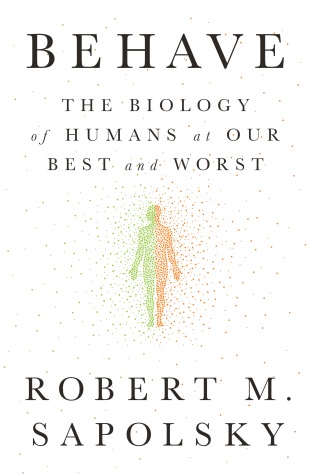
Behave: The Biology of Humans at Our Best and Worst
My Thoughts :
This book is truly a gem. Although it is too lengthy and can get very technical sometimes but overall it is a brilliant book. As someone who did not major in neuroscience, sociology, or biology, I was captivated by the subject and I found myself learning a great deal from this book. Robert Sapolsky is a very knowledgeable scientist and his ability to engage readers is remarkable. I particularly enjoyed his playful writing style and his use of humour to bring life to the book. Also, the whole book is well structured and flows nicely from chapter to chapter. I like how he guides us through the human thought process, from the firing of neurons in our brains to the evolutionary forces that have shaped our behaviour. Truly a magnificent read.
Details :
- Author : Robert M. Sapolsky
- Release Date : 2017
- Publisher : Penguin Random House
- ISBN : 9780099575061
Read : 20 Mar 2024 - 10 May 2024
Favourite Quotes :
Which reminds us that we don’t hate aggression; we hate the wrong kind of aggression but love it in the right context. And conversely, in the wrong context our most laudable behaviors are anything but. [19] When we stop fearing something, it isn’t because some amygdaloid neurons have lost their excitability. We don’t passively forget that something is scary. We actively learn that it isn’t anymore. [38] This has two implications. Both sex and aggression activate the sympathetic nervous system, which in turn can influence behavior—people feel differently about things if, say, their heart is racing versus beating slowly. Does this mean that the pattern of your autonomic arousal influences what you feel? Not really. But autonomic feedback influences the intensity of what is felt. [44] A simplistic view is that the vmPFC and dlPFC perpetually battle for domination by emotion versus cognition. But while emotion and cognition can be somewhat separable, they’re rarely in opposition. Instead they are intertwined in a collaborative relationship needed for normal function, and as tasks with both emotive and cognitive components become more difficult (making an increasingly complex economic decision in a setting that is increasingly unfair), activity in the two structures becomes more synchronized. [58] This raises the specter of envy. In one neuroimaging study subjects read about a hypothetical person’s academic record, popularity, attractiveness, and wealth.84 Descriptions that evoked self-reported envy activated cortical regions involved in pain perception. Then the hypothetical individual was described as experiencing a misfortune (e.g., they were demoted). More activation of pain pathways at the news of the person’s good fortune predicted more dopaminergic activation after learning of their misfortune. Thus there’s dopaminergic activation during schadenfreude—gloating over an envied person’s fall from grace. [67] Once, during a concert of cathedral organ music, as I sat getting gooseflesh amid that tsunami of sound, I was struck with a thought: for a medieval peasant, this must have been the loudest human-made sound they ever experienced, awe-inspiring in now-unimaginable ways. No wonder they signed up for the religion being proffered. And now we are constantly pummeled with sounds that dwarf quaint organs. Once, hunter-gatherers might chance upon honey from a beehive and thus briefly satisfy a hardwired food craving. And now we have hundreds of carefully designed commercial foods that supply a burst of sensation unmatched by some lowly natural food. Once, we had lives that, amid considerable privation, also offered numerous subtle, hard-won pleasures. And now we have drugs that cause spasms of pleasure and dopamine release a thousandfold higher than anything stimulated in our old drug-free world. [69] An emptiness comes from this combination of over-the-top nonnatural sources of reward and the inevitability of habituation; this is because unnaturally strong explosions of synthetic experience and sensation and pleasure evoke unnaturally strong degrees of habituation.90 This has two consequences. First, soon we barely notice the fleeting whispers of pleasure caused by leaves in autumn, or by the lingering glance of the right person, or by the promise of reward following a difficult, worthy task. And the other consequence is that we eventually habituate to even those artificial deluges of intensity. If we were designed by engineers, as we consumed more, we’d desire less. But our frequent human tragedy is that the more we consume, the hungrier we get. More and faster and stronger. What was an unexpected pleasure yesterday is what we feel entitled to today, and what won’t be enough tomorrow. [70] In other words, dopamine is not about the happiness of reward. It’s about the happiness of pursuit of reward that has a decent chance of occurring. [74] This generates some complex interactions. For example, activate the vmPFC or inactivate the dlPFC, and short-term reward becomes more alluring. And a cool neuroimaging study of Knutson’s gives insight into impatient people with steep temporal discounting curves; their accumbens, in effect, underestimates the magnitude of the delayed reward, and their dlPFC overestimates the length of the delay. [75] Though the dopamine system is similar across numerous species, humans do something utterly novel: we delay gratification for insanely long times. No warthog restricts calories to look good in a bathing suit next summer. No gerbil works hard at school to get good SAT scores to get into a good college to get into a good grad school to get a good job to get into a good nursing home. We do something even beyond this unprecedented gratification delay: we use the dopaminergic power of the happiness of pursuit to motivate us to work for rewards that come after we are dead—depending on your culture, this can be knowing that your nation is closer to winning a war because you’ve sacrificed yourself in battle, that your kids will inherit money because of your financial sacrifices, or that you will spend eternity in paradise. It is extraordinary neural circuitry that bucks temporal discounting enough to allow (some of) us to care about the temperature of the planet that our great-grandchildren will inherit. Basically, it’s unknown how we humans do this. We may merely be a type of animal, mammal, primate, and ape, but we’re a profoundly unique one. [76] One person’s “terrorist” is another’s “freedom fighter” [93] Subjects decide whether to administer a hypothetical drug. If they’re told, “The drug has a 95 percent survival rate,” people, including doctors, are more likely to approve it than when told, “The drug has a 5 percent death rate.” [93] Testosterone boosts impulsivity and risk taking, making people do the easier thing when it’s the dumb-ass thing to do. [103] So is testosterone causing action potentials in these neurons? No. It’s causing them to fire at a faster rate if they are stimulated by something else. Similarly, testosterone increases amygdala response to angry faces, but not to other sorts. Thus, if the amygdala is already responding to some realm of social learning, testosterone ups the volume. [105] Thus, testosterone’s actions are contingent and amplifying, exacerbating preexisting tendencies toward aggression rather than creating aggression out of thin air. [105] In our world riddled with male violence, the problem isn’t that testosterone can increase levels of aggression. The problem is the frequency with which we reward aggression. [107] Obviously, oxytocin and vasopressin are the grooviest hormones in the universe.* Pour them into the water supply, and people will be more charitable, trusting, and empathic. We’d be better parents and would make love, not war (mostly platonic love, though, since people in relationships would give wide berths to everyone else). Best of all, we’d buy all sorts of useless crap, trusting the promotional banners in stores once oxytocin starts spraying out of the ventilation system. [113] Oxytocin, the luv hormone, makes us more prosocial to Us and worse to everyone else. That’s not generic prosociality. That’s ethnocentrism and xenophobia. In other words, the actions of these neuropeptides depend dramatically on context—who you are, your environment, and who that person is. [117] Mobilizing energy while sprinting for your life helps save you. Do the same thing chronically because of a stressful thirty-year mortgage, and you’re at risk for various metabolic problems, including adult-onset diabetes. [126] We have a dichotomy—if you’re stressed like a normal mammal in an acute physical crisis, the stress response is lifesaving. But if instead you chronically activate the stress response for reasons of psychological stress, your health suffers. It is a rare human who sickens because they can’t activate the stress response when it is needed. Instead, we get sick from activating the stress response too often, too long, and for purely psychological reasons. Crucially, the beneficial effects of the stress response for sprinting zebras and lions play out over the course of seconds to minutes. But once you take stress to the time course of this chapter (henceforth referred to as “sustained” stress), you’ll be dealing with adverse consequences. [127] Sustained stress has numerous adverse effects. The amygdala becomes overactive and more coupled to pathways of habitual behavior; it is easier to learn fear and harder to unlearn it. We process emotionally salient information more rapidly and automatically, but with less accuracy. Frontal function—working memory, impulse control, executive decision making, risk assessment, and task shifting—is impaired, and the frontal cortex has less control over the amygdala. And we become less empathic and prosocial. Reducing sustained stress is a win-win for us and those stuck around us. [136] Similarly, neuroplasticity makes the functional malleability of the brain tangible, makes it “scientifically demonstrated” that brains change. That people change. In the time span considered in this chapter, people throughout the Arab world went from being voiceless to toppling tyrants; Rosa Parks went from victim to catalyst, Sadat and Begin from enemies to architects of peace, Mandela from prisoner to statesman. And you’d better bet that changes along the lines of those presented in this chapter occurred in the brains of anyone transformed by these transformations. A different world makes for a different worldview, which means a different brain. And the more tangible and real the neurobiology underlying such change seems, the easier it is to imagine that it can happen again. [153] On a certain level the biology underlying the teenaged mugger is similar to that of the teen who joins the Ecology Club and donates his allowance to help save the mountain gorillas. It’s the usual—heightened emotional intensity, craving for peer approval, novelty seeking, and, oh, that frontal cortex. But that’s where similarities end. [170] Adult life is filled with consequential forks in the road where the right thing is definitely harder. Navigating these successfully is the portfolio of the frontal cortex, and developing the ability to do this right in each context requires profound shaping by experience. [173] But from birth through young adulthood, the part of the human brain that most defines us is less a product of the genes with which you started life than of what life has thrown at you. Because it is the last to mature, by definition the frontal cortex is the brain region least constrained by genes and most sculpted by experience. This must be so, to be the supremely complex social species that we are. Ironically, it seems that the genetic program of human brain development has evolved to, as much as possible, free the frontal cortex from genes. [173] As we saw, mammalian fetuses overproduce neurons and synapses; ineffective or unessential synapses and neurons are pruned, producing leaner, meaner, more efficient circuitry. To reiterate a theme from the last chapter, the later a particular brain region matures, the less it is shaped by genes and the more by environment. [175] Yes, very rudimentary. Maybe the toddler feels profound empathy. Or maybe she’s just distressed by the crying and is self-interestedly trying to quiet the adult. The childhood capacity for empathy progresses from feeling someone’s pain because you are them, to feeling for the other person, to feeling as them. [179] Why do we often become attached to a source of negative reinforcement, seek solace when distressed from the cause of that distress? Why do we ever love the wrong person, get abused, and return for more? Psychological insights abound. Because of poor self-esteem, believing you’ll never do better. Or a codependent conviction that it’s your calling to change the person. Maybe you identify with your oppressor, or have decided it’s your fault and the abuser is justified, so they seem less irrational and terrifying. These are valid and can have huge explanatory and therapeutic power. [192] childhood poverty impairs maturation of the corpus callosum, a bundle of axonal fibers connecting the two hemispheres and integrating their function. This is so wrong—foolishly pick a poor family to be born into, and by kindergarten, the odds of your succeeding at life’s marshmallow tests are already stacked against you. [196] Collectivist cultures emphasize interdependence, harmony, fitting in, the needs and responsibilities of the group; in contrast, individualist cultures value independence, competition, the needs and rights of the individual. [206] This challenged dogma that sexual identity is due to social, not biological, influences. This was the view of sociologists who hated high school biology . . . and of the medical establishment as well. [213] Can there be mutations in DNA stretches constituting promoters? Yes, and more often than in genes themselves. In the 1970s Allan Wilson and Mary-Claire King at Berkeley correctly theorized that the evolution of genes is less important than the evolution of regulatory sequences upstream of genes (and thus how the environment regulates genes). Reflecting that, a disproportionate share of genetic differences between chimps and humans are in genes for TFs. [228] Genes are not autonomous agents commanding biological events. • Instead, genes are regulated by the environment, with “environment” consisting of everything from events inside the cell to the universe. • Much of your DNA turns environmental influences into gene transcription, rather than coding for genes themselves; moreover, evolution is heavily about changing regulation of gene transcription, rather than genes themselves. • Epigenetics can allow environmental effects to be lifelong, or even multigenerational. • And thanks to transposons, neurons contain a mosaic of different genomes. In other words, genes don’t determine much. This theme continues as we focus on the effects of genes on behavior. [233] This is crucial: Study a gene in only one environment and, by definition, you’ve eliminated the ability to see if it works differently in other environments (in other words, if other environments regulate the gene differently). And thus you’ve artificially inflated the importance of the genetic contribution. The more environments in which you study a genetic trait, the more novel environmental effects will be revealed, decreasing the heritability score. [244] This suggests a radical conclusion: it’s not meaningful to ask what a gene does, just what it does in a particular environment. This is summarized wonderfully by the neurobiologist Donald Hebb: “It is no more appropriate to say things like characteristic A is more influenced by nature than nurture than . . . to say that the area of a rectangle is more influenced by its length than its width.” It’s appropriate to figure out if lengths or widths explain more of the variability in a population of rectangles. But not in individual ones. [248] Thus, for our purposes, genes aren’t about inevitability. Instead they’re about context-dependent tendencies, propensities, potentials, and vulnerabilities. All embedded in the fabric of the other factors, biological and otherwise, that fill these pages. [265] A final depressing point about inequality and violence. As we’ve seen, a rat being shocked activates a stress response. But a rat being shocked who can then bite the hell out of another rat has less of a stress response. Likewise with baboons—if you are low ranking, a reliable way to reduce glucocorticoid secretion is to displace aggression onto those even lower in the pecking order. It’s something similar here—despite the conservative nightmare of class warfare, of the poor rising up to slaughter the wealthy, when inequality fuels violence, it is mostly the poor preying on the poor. [295] Finally, life in larger populations fosters the ultimate third-party punisher. As documented by Ara Norenzayan of the University of British Columbia, it is only when societies grow large enough that people regularly encounter strangers that “Big Gods” emerge—deities who are concerned with human morality and punish our transgressions.45 Societies with frequent anonymous interactions tend to outsource punishment to gods.* In contrast, hunter-gatherers’ gods are less likely than chance to care whether we’ve been naughty or nice. [297] Theories abound as to why humans keep inventing religions. It’s more than a human pull toward the supernatural; as stated in one review, “Mickey Mouse has supernatural powers, but no one worships or would fight—or kill—for him. Our social brains may help explain why children the world over are attracted to talking teacups, but religion is much more than that.” Why does religion arise? Because it makes in-groups more cooperative and viable (stay tuned for more in the next chapter). Because humans need personification and to see agency and causality when facing the unknown. Or maybe inventing deities is an emergent by-product of the architecture of our social brains. [304] Measure after measure, it’s the same. We aren’t classically monogamous or polygamous. As everyone from poets to divorce attorneys can attest, we are by nature profoundly confused—mildly polygynous, floating somewhere in between. [366] Human irrationality in distinguishing kin from nonkin takes us to the heart of our best and worst behaviors. This is because of something crucial—we can be manipulated into feeling more or less related to someone than we actually are. When it is the former, wonderful things happen—we adopt, donate, advocate for, empathize with. We look at someone very different from us and see similarities. It is called pseudokinship. And the converse? One of the tools of the propagandist and ideologue drumming up hatred of the out-group—blacks, Jews, Muslims, Tutsis, Armenians, Roma—is to characterize them as animals, vermin, cockroaches, pathogens. So different that they hardly count as human. It’s called pseudospeciation. [372] Us/Them-ing typically involves inflating the merits of Us concerning core values—we are more correct, wise, moral, and worthy when it comes to knowing what the gods want/running the economy/raising kids/fighting this war. Us-ness also involves inflating the merits of our arbitrary markers, and that can take some work—rationalizing why our food is tastier, our music more moving, our language more logical or poetic. Perhaps even more than superiority, feelings about Us center on shared obligations, on willingness and expectation of mutuality.12 The essence of an Us mind-set is nonrandom clustering producing higher-than-expected frequencies of positive interactions. [393] It’s problematic when non–zero sum games are viewed as zero-sum (winner-take-all).18 It’s not a great mind-set to think you’ve won World War III if afterward Us have two mud huts and three fire sticks and They have only one of each.* A horrific version of this thinking occurred late during World War I, when the Allies knew they had more resources (i.e., soldiers) than Germany. Therefore, the British commander, Douglas Haig, declared a strategy of “ceaseless attrition,” where Britain went on the offensive, no matter how many of his men were killed—as long as the Germans lost at least as many. So in-group parochialism is often more concerned about Us beating Them than with Us simply doing well. This is the essence of tolerating inequality in the name of loyalty. [395] Thems are also frequently viewed as simpler and more homogeneous than Us, with simpler emotions and less sensitivity to pain. David Berreby, in his superb book Us and Them: The Science of Identity, gives a striking example, namely that whether it was ancient Rome, medieval England, imperial China, or the antebellum South, the elite had the system-justifying stereotype of slaves as simple, childlike, and incapable of independence. [399] The “confirmation biases” used to rationalize and justify automatic Them-ing are numerous—remembering supportive better than opposing evidence; testing things in ways that can support but not negate your hypothesis; skeptically probing outcomes you don’t like more than ones you do. [404] Thus, we tend to think of Us as noble, loyal, and composed of distinctive individuals whose failings are due to circumstance. Thems, in contrast, seem disgusting, ridiculous, simple, homogeneous, undifferentiated, and interchangeable. All frequently backed up by rationalizations for our intuitions. That is a picture of an individual navigating Us/Them in his mind. Interactions between groups tend to be more competitive and aggressive than are interactions between individual Us-es and Thems. In the words of Reinhold Niebuhr, writing during World War II, “The group is more arrogant, hypocritical, self-centered and more ruthless in the pursuit of its ends than the individual." [404] But these intuitions are flimsy. First, while there are obvious biological contributions to racial differences, “race” is a biological continuum rather than a discrete category—for example, unless you cherry-pick the data, genetic variation within race is generally as great as between races. And this really is no surprise when looking at the range of variation with a racial rubric—compare Sicilians with Swedes or a Senegalese farmer with an Ethiopian herder. [407] the notion of race as a fixed, biologically based classification system doesn’t work either. At various times in the history of the U.S. census, “Mexican” and “Armenian” were classified as distinctive races; southern Italians were of a different race from northern Europeans; someone with one black great-grandparent and seven white ones was classified as white in Oregon but not Florida. This is race as a cultural rather than biological construct. [407] Predictably, making hierarchies steeper, more consequential, or more overt worsens Them-ing; the need for justification fuels those on top to pour the stereotypes of, at best, high warmth/low competence or, worse, low warmth/low competence onto the heads of those struggling at the bottom, and those on the bottom reciprocate with the simmering time bomb that is the perception of the ruling class as low warmth/high competence. [421] Hierarchies establish a status quo by ritualizing inequalities. [426] Those with the most interest in prestige and power seem least likely to feel for those less fortunate. [440] It certainly helps to know that you are not alone, that there are others who are willing to resist, that there are those who have done so in the past. But often something still holds us back. Eichmann’s seeming normalcy supplied us, thanks to Hannah Arendt, with the notion of the banality of evil. Zimbardo, in his recent writing, emphasizes the “banality of heroism.” As discussed in various chapters, people who heroically refuse to look the other way, who do the right thing even when it carries the ultimate cost—tend to be surprisingly normal. The stars didn’t align at their births; doves of peace did not envelop them where they strode. They put their pants on one leg at a time. This should be a huge source of strength for us. [475] Like so many other animals, we have an often-frantic need to conform, belong, and obey. Such conformity can be markedly maladaptive, as we forgo better solutions in the name of the foolishness of the crowd. When we discover we are out of step with everyone else, our amygdalae spasm with anxiety, our memories are revised, and our sensory-processing regions are even pressured to experience what is not true. All to fit in. [477] What is it about worldwide religions? As we saw in chapter 9, it is only when groups get large enough that people regularly interact with strangers that cultures invent moralizing gods. These are not gods who sit around the banquet table laughing with detachment at the foibles of humans down below, or gods who punish humans for lousy sacrificial offerings. These are gods who punish humans for being rotten to other humans—in other words, the large religions invent gods who do third-party punishment. No wonder this predicts these religions’ adherents being third-party punishers themselves. [499] The thing that makes the tragedy of commonsense morality so tragic is the intensity with which you just know that They are deeply wrong. In general, our morally tinged cultural institutions—religion, nationalism, ethnic pride, team spirit—bias us toward our best behaviors when we are single shepherds facing a potential tragedy of the commons. They make us less selfish in Me versus Us situations. But they send us hurtling toward our worst behaviors when confronting Thems and their different moralities. [511] All things considered, it is a pretty remarkable thing that when an individual is in pain, we (i.e., we humans, primates, mammals) often are induced to be in a state of pain also. There have been some mighty interesting twists and turns for that one to have evolved. But at the end of the day, the crucial issue is whether an empathic state actually produces a compassionate act, to avoid the trap of empathy being an end unto itself. The gap between the state and the act can be enormous, especially when the goal is for the act to be not only effective but also pristine in its motives. [550] For Lakoff language is always a metaphor, transferring information from one individual to another by putting thought into words, as if words were shopping bags. [558] And what about religion facilitating the worst in us, with respect to Thems? Well, one piece of evidence for this is, uh, like, human history. Every major religion has historical blood on its hands—Buddhist monks led the persecution of Rohingya Muslims in Burma, and a Quaker in the White House oversaw the carpet bombing of North Vietnam for Christmas.*15 This ranges from religious wars, which are, to cite a quote generally attributed to Napoleon, “people killing each other over who has the better imaginary friend,” to secular ones where, nevertheless, omniscient support is requested and proclaimed. Religion is a particularly tenacious catalyst of violence. Catholics and Protestants have been killing each other in Europe for nearly 500 years, Shiites and Sunnis for 1,300. [624] After all, you can’t readily reason yourself out of a belief that you weren’t originally reasoned into. [643] The actual fighters are a tiny subset. As stated by one researcher, “humans are bad at [close-range, hand-to-hand] violence, even if civilization makes us a bit better at it.”43 Even more interesting is the evidence of our strong inhibitions against doing grievous harm to someone up close. [644] But outside those motivations, humans show a strong natural aversion to killing at close range. The most resistance is against hand-to-hand combat with a knife or bayonet. Next comes short-range firing with a pistol, then long-range firing, all the way to the easiest, which is bombs and artillery. [645] Somewhere between neurons, hormones, and genes on one hand and culture, ecological influences, and evolution on the other, sits the individual. And with more than seven billion of us, it’s easy to feel that no single individual can make much of a difference. But we know that’s not true. There’s the obligatory list of those who changed everything—Mandela, Gandhi, MLK, Rosa Parks, Lincoln, Aung San Suu Kyi. Yes, they often had scads of advisers. But they were the catalysts, the ones who paid with their freedom or their lives. And there are whistle-blowers who took great risks to trigger change—Daniel Ellsberg, Karen Silkwood, W. Mark Felt (Watergate’s Deep Throat), Samuel Provance (the U.S. soldier who revealed the abuses at Abu Ghraib Prison), Edward Snowden. [652]