


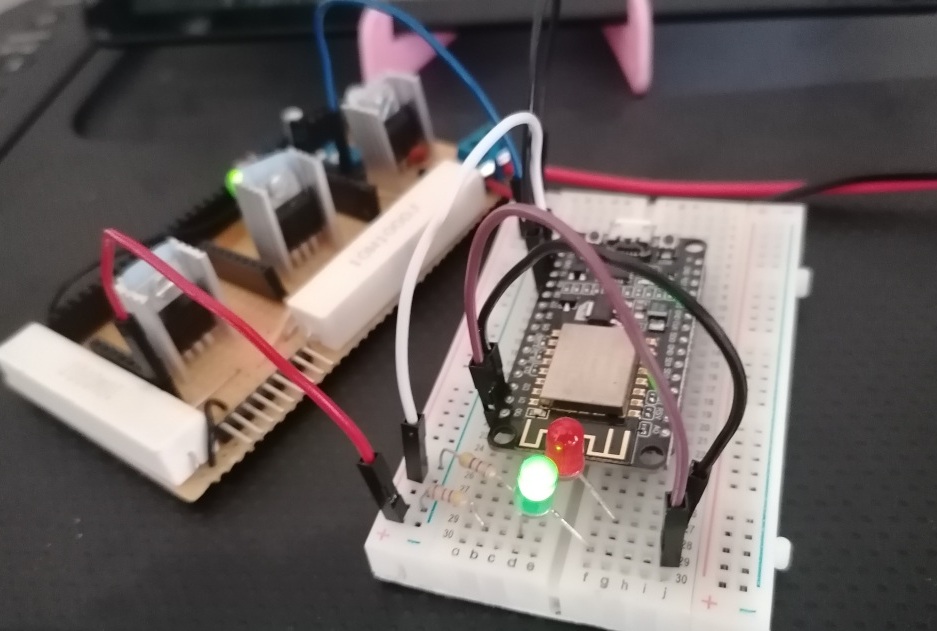
ESP8266-Based Remote Battery Monitoring and Low-Level Indication
Date : 16 August 2024GIT Repository : view
Posted on : 17 Aug 2024
Tag(s) : ESP8266, Remote-Monitoring, Arduino
This project involves the development of a system for remotely monitoring the battery level of a device and providing a visual indication when the battery is low. The system is built around the ESP8266 WiFi module, which periodically connects to a server via HTTP to retrieve the current battery status. If the battery level is determined to be low, the system activates an LED to signal that the device requires charging.
Project Motivation
In many Internet of Things (IoT) applications, devices are often deployed in locations where they are not easily accessible or do not have a display to show battery status. The ability to remotely monitor battery levels is crucial in such scenarios to prevent unexpected downtime due to battery depletion. This project provides a simple yet effective solution for addressing this challenge by using an ESP8266 module to fetch and display battery information remotely.
Technical Overview
The core of the system is the NodeMCU ESP8266 12-E WiFi module, which is programmed using the Arduino framework in the PlatformIO IDE within Visual Studio Code. The module periodically sends an HTTP request to a specified server to fetch the battery level, which is expected to be provided in a JSON format. Based on the retrieved data, the system determines whether the battery level is below a predefined threshold, and if so, an LED is activated as a low-level indicator.
System Requirements
To set up this project, you will need the following:
- Hardware: NodeMCU ESP8266 12-E module, 3.3V Regulated Power Supply, some LEDs and resistors.
- Software: PlatformIO IDE in Visual Studio Code, and the ArduinoJson library for parsing JSON responses.
Server API and Response Format
The server that the ESP8266 module connects to should return a JSON response containing the battery level. The expected format of the response is as follows:
{ "battery": 75, "param2": "value2" }In this response, the "battery" parameter is an integer representing the battery level as a percentage. The system uses this value to determine whether the battery is low and to trigger the LED indicator accordingly.
Configuration Instructions
To configure the ESP8266 module for your network and server, follow these steps:
- Clone or Fork the project on my Git repository
- Wi-Fi Configuration: Open the
src/main.cppfile and enter your Wi-Fi credentials: - Server URL: Specify the URL of your server where the battery status can be retrieved:
- Optional API Key: If your server requires authentication, you can include an API key or token in the request:
const char *wifi_ssid = "YOUR_WIFI_SSID"; // Replace with your values
					const char *wifi_password = "YOUR_WIFI_PASSWORD"; // Replace with your values
const char *hostURL = "http://YOUR_SERVER_DOMAIN/PATH"; // Replace with your values
String httpRequestData = "auth=YOUR_API_KEY&deviceId=esp8266_nmcu_12e";
Conclusion
This project provides a practical solution for remote battery monitoring and low-level indication in IoT applications. By leveraging the ESP8266 WiFi module, developers can easily integrate this functionality into their systems, ensuring that devices remain operational and do not suffer unexpected power loss. Future enhancements will include automatic battery charging mechanisms, further extending the utility of this system.
Other links related to this project
- SMSHub Connect : SMSHub Connect Android App